Revolutionizing Protein Design: PLAID's Promise and Potential
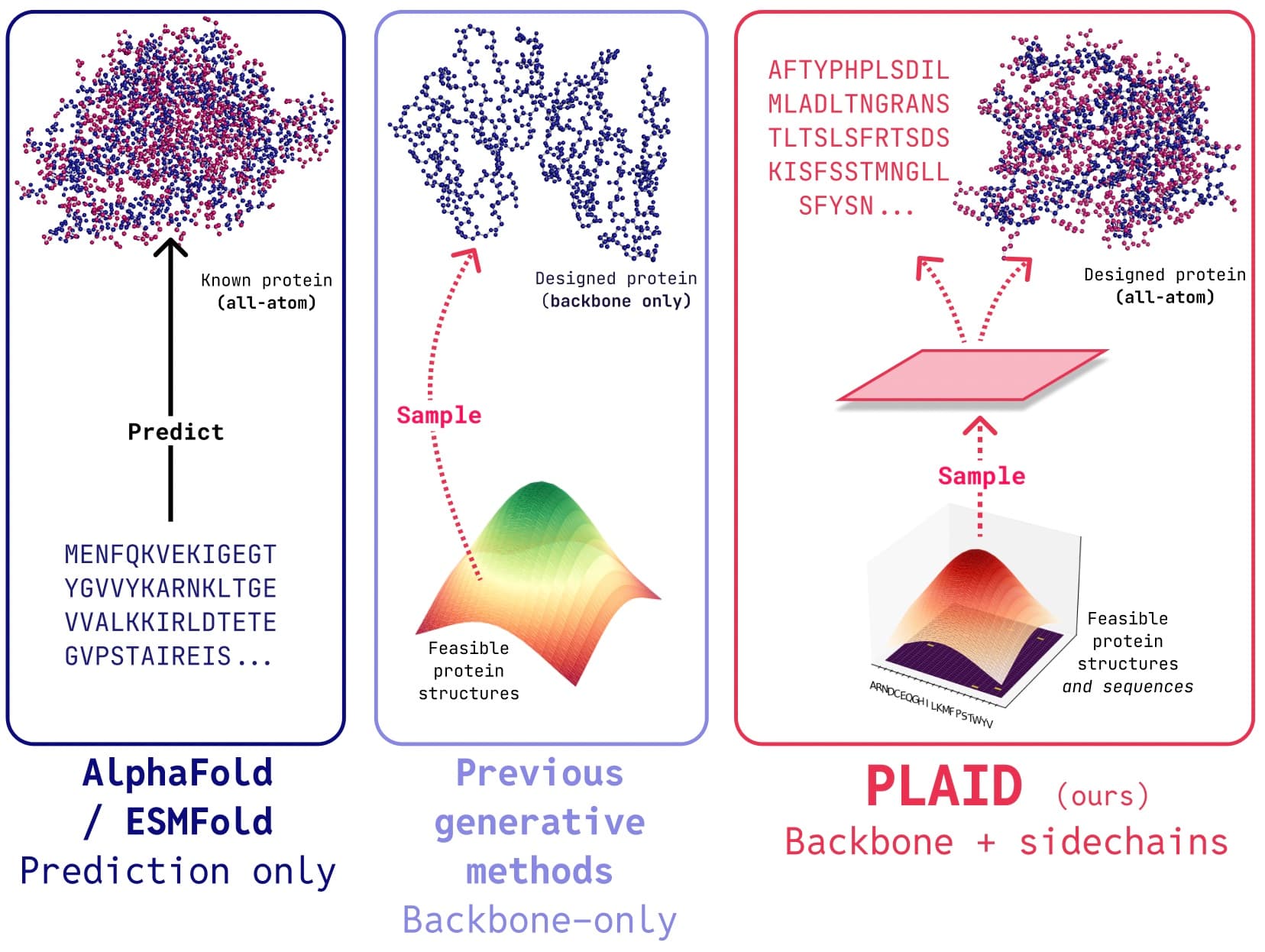
PLAID, a generative model from Berkeley AI Research, is changing how we create proteins by tapping into latent diffusion. This innovation could transform drug design by generating useful proteins from sequence data.
In a significant leap forward for computational biology, Berkeley AI Research has introduced a groundbreaking approach to protein design with PLAID. This new generative model harnesses the latent diffusion within protein folding models to simultaneously generate a protein's 1D sequence and 3D structure. With the awarding of the 2024 Nobel Prize to AlphaFold2 underscoring AI's potential in biology, PLAID represents the next logical step.
Beyond Protein Folding
PLAID's innovation lies in its ability to learn and sample from the latent space of protein folding models, effectively generating new proteins based on compositional function and organism prompts. By training on vast sequence databases, up to 10,000 times larger than structural ones, PLAID tackles the complex problem of multimodal co-generation, synthesizing both sequence and all-atom structures. This is a significant departure from previous models that often fell short in real-world applications due to their limited scope.
Tackling Real-World Challenges
While diffusion models have shown potential in protein generation, real-world applications demand more. For instance, generating all-atom structures is key for practical applications, yet many models only produce backbone atoms. PLAID overcomes this by generating both discrete sequences and continuous structural data. Additionally, organism-specific constraints, like humanization to avoid immune responses, are key in drug design, a consideration PLAID addresses. But, can this model truly handle the complex, nuanced constraints of drug delivery, like solubility for transport-friendly formulations?
Seizing the Opportunity
The real breakthrough with PLAID is its reliance on sequence-only training data, unlocking a larger dataset for training. This approach parallels vision-language-action models in robotics, using pre-trained knowledge to guide new applications. PLAID's methodology is analogous, using structural insights from protein folding models like ESMFold to help sequence and structure generation. But here's a question: Could this methodology be adapted to other complex systems, beyond proteins, using abundant to less abundant modality mapping?
The development of CHEAP, a companion model compressing the latent space, addresses the challenge of high-resolution synthesis in large embedding spaces. This compression enhances mechanistic interpretability, showcasing the potential for highly versatile and efficient protein generation models.
The Future of Protein Design
PLAID's promise extends beyond protein sequences and structures. By adapting its approach to multi-modal generation for various systems, the potential applications are vast. For instance, predicting proteins in complex environments or interactions with other biomolecules could redefine pharmaceutical research and development. This initiative from Berkeley AI Research isn’t just a technical achievement. It’s a stepping stone towards more responsive, customized drug design. Who wouldn’t want a future where medicine is tailored with this precision? As sequence-to-structure predictions continue to evolve, PLAID sets a new standard for what’s achievable in protein design.
Get AI news in your inbox
Daily digest of what matters in AI.
Key Terms Explained
A dense numerical representation of data (words, images, etc.
The compressed, internal representation space where a model encodes data.
AI models that can understand and generate multiple types of data — text, images, audio, video.
The process of teaching an AI model by exposing it to data and adjusting its parameters to minimize errors.