Why RAFT is the Real Deal in Time Series Forecasting
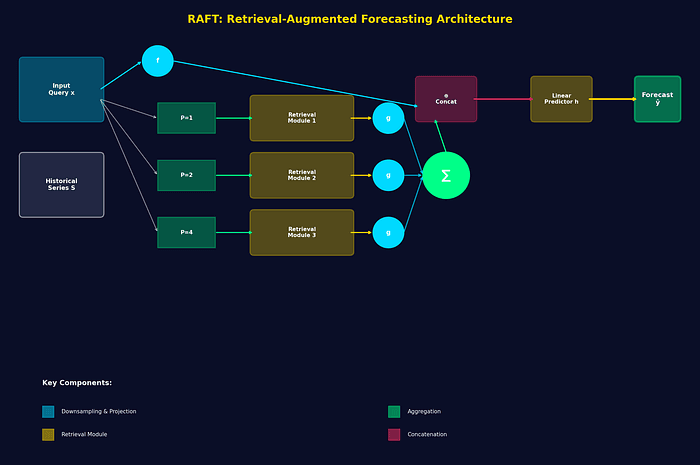
Forget about beefing up your models with more parameters. RAFT's smarter approach relies on retrieval systems to boost forecasting accuracy.
Ever tried reading the entire Cheesecake Factory menu? It's a beast at 21 pages long. Now, what if I told you that time series forecasting, we've been doing something similar, relying on larger and larger models to capture patterns instead of being smart about it?
What's RAFT All About?
Meet RAFT, or Retrieval-Augmented Forecasting of Time-series. Instead of relying on bloated models with massive parameter counts, RAFT opts for a more elegant solution. It uses a retrieval system that taps into historical data, enhancing forecasting performance while maintaining a lightweight architecture. Sounds refreshing, doesn't it?
Traditional models like Transformers are the go-to, but they're overkill for many tasks. RAFT challenges this by showing that models don't need more weight, they need a better library card. Why memorize patterns when you can just look them up? This ends badly. The data already knows it.
Why Should You Care?
Here's the kicker: RAFT isn't just a neat theory. It's a practical shift that could save companies millions by optimizing resources. Overfitting and forgetting those rare but critical events are issues that plague traditional models. RAFT sidesteps these problems, providing a more reliable forecast for businesses that can't afford to gamble on inaccurate predictions.
So why isn't everyone adopting RAFT? Well, change scares people. The tech world is bullish on hopium, constantly chasing the latest, greatest model without stepping back to question if there's a smarter way.
Is It Time to Ditch the Heavyweights?
Here's a rhetorical question for you: Do we need to keep feeding the beast with more parameters, or are we ready to embrace a smarter, more efficient approach? RAFT might just be the beginning of a new era in forecasting. It's time to zoom out. No, further. See it now?
In a world obsessed with size, RAFT shows us that sometimes, less is more. The question is, when will the rest of the industry catch on? Everyone has a plan until liquidation hits.
Get AI news in your inbox
Daily digest of what matters in AI.
Key Terms Explained
When a model memorizes the training data so well that it performs poorly on new, unseen data.
A value the model learns during training — specifically, the weights and biases in neural network layers.
A numerical value in a neural network that determines the strength of the connection between neurons.