Vine-Inspired Robots: The Future of Gentle Lifting
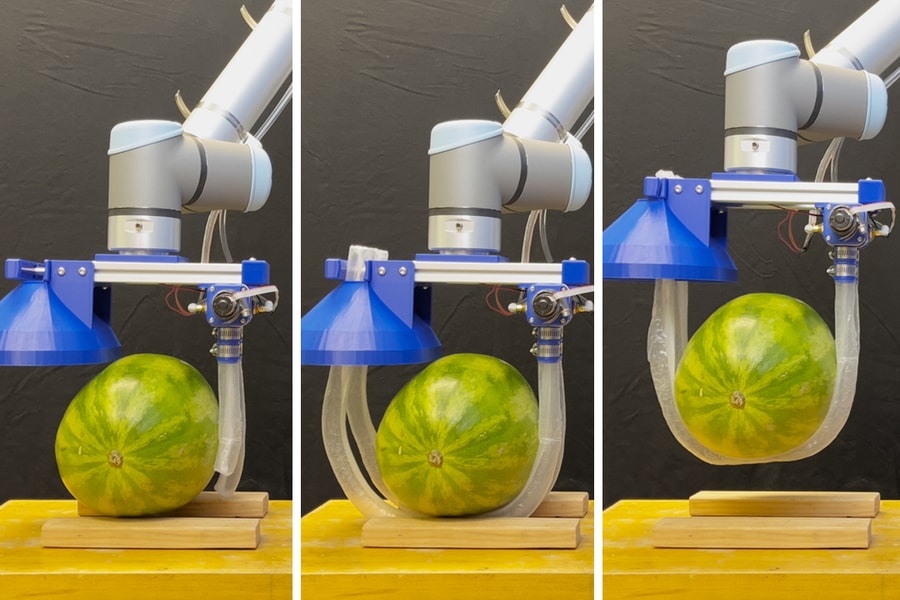
MIT and Stanford engineers have created a vine-inspired robot capable of lifting heavy and delicate objects. This technology could revolutionize eldercare and other industries.
Imagine a robot gripper that emulates the dexterity of vines, allowing it to gently lift anything from a glass vase to a watermelon. That's exactly what engineers at MIT and Stanford University have achieved with their latest invention. These robotic tendrils, which inflate and grow out of a pressurized box, represent a significant step forward in robotic design.
Inspired by Nature
In the natural world, vines wrap themselves around any obstacle in their path, exerting enough force to topple trees. The team at MIT and Stanford has mimicked this behavior to create a robot that can snake around and lift objects with a soft, sling-like grip. This approach diverges from traditional, often clunky, robot grippers that might struggle with delicate or heavy items.
Barhydt, a PhD candidate at MIT, explains that this technology could fundamentally change how we handle lifting tasks in eldercare settings. With an aging population, the demand for safe and efficient patient transfer is growing. Current methods require significant physical effort from caregivers. This new robot offers a gentler, more comfortable experience for patients.
Beyond Eldercare
The applications for this technology extend beyond healthcare. Think about industries like agriculture or heavy cargo loading. The robot can thread through tight spaces and grasp objects without causing damage. We're witnessing the AI-AI Venn diagram getting thicker as these sectors start to converge with robotics innovation.
What if we could automate crane operations at ports using a similar technology? The implications for efficiency and safety are enormous. The potential to replace costly, high-risk tasks with a gentle, vine-inspired robot is a compelling proposition.
Closing the Loop
One of the key breakthroughs is the robot's ability to transform from an open-loop design, where it acts like a string, into a closed loop capable of lifting objects. This innovation creates a secure grasp around whatever the robot 'hugs.' In essence, the compute layer needs a payment rail, and this robot might just be the start of that infrastructure.
While the development was primarily focused on eldercare, the potential adaptations are manifold. The team has already demonstrated a smaller version that can attach to commercial robotic arms, lifting items as varied as a glass vase and a stack of metal rods.
We're building the financial plumbing for machines, and this vine-inspired robot is a testament to how AI and robotics aren't merely advancing in isolation. The convergence between nature-inspired design and robotic autonomy is a trend that's likely to shape the future of technology in ways we can only begin to imagine.
Get AI news in your inbox
Daily digest of what matters in AI.