Unveiling Word2Vec: Decoding Language Through Mathematics
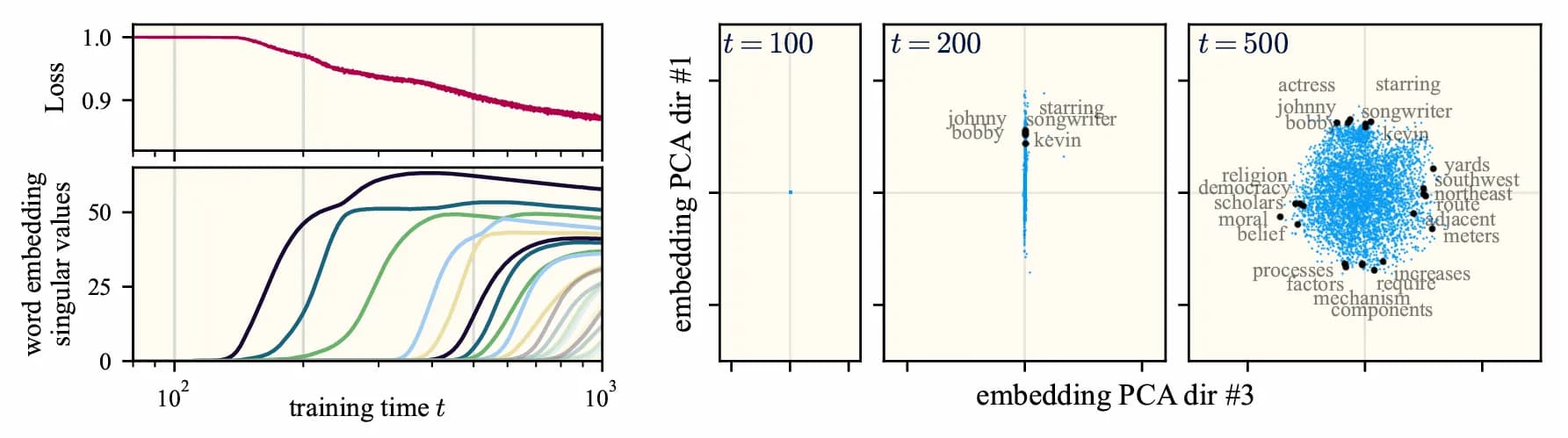
Word2Vec, a cornerstone in language modeling, gains a new theoretical understanding. Researchers have successfully mapped its learning process to unweighted least-squares matrix factorization, revealing how it captures language semantics.
Word2Vec, long a stalwart in the area of natural language processing, has just had its mysteries unraveled by researchers who’ve crafted a comprehensive theory about its functionality. The question of what exactly Word2Vec learns has been answered by showing that its learning process can be reduced to unweighted least-squares matrix factorization. Intriguingly, the final learned representations align with what we know as Principal Component Analysis (PCA).
Decoding the Learning Process
In the context of Word2Vec, this theory suggests that when embeddings are initialized close to zero, they develop discrete concepts sequentially. Think of it as learning a new language. At first, all you hear is noise, but over time, distinct words and meanings start to stand out. Word2Vec effectively enhances its capacity by expanding the dimensional space of its embeddings, which is visualized through a series of rank-incrementing learning steps.
These steps aren't arbitrary. Through careful inspection, it’s evident each step unearths a new 'concept', which in reality is an orthogonal linear subspace. This linear representation is quite compelling, as it allows the model to complete analogies such as 'man: woman :: king: queen' through basic vector arithmetic.
Feature Discovery in Language
In practical terms, the latent features Word2Vec identifies are the top eigenvectors of a specific matrix defined by corpus statistics and certain algorithmic parameters. This matrix, when constructed using data like Wikipedia, reveals striking patterns. The top eigenvector might highlight terms associated with celebrity, while others may zero in on government or geography. It's a fascinating insight into how language can be distilled into mathematical forms.
Why should this matter to us? Because understanding these patterns isn't just academic. It's foundational to the development of more sophisticated models, which will ultimately drive innovations in AI's ability to understand and generate human language.
Implications and Future Prospects
The study not only sheds light on Word2Vec’s internal workings but also sets the stage for understanding feature learning in more advanced models. The idea that such models could be broken down into a series of closed-form solutions is a breakthrough. It demystifies what’s been a black box for many, offering a roadmap for refining AI language models.
But here’s the kicker: while theoretically elegant, the model still grapples with noise, potentially degrading its ability to resolve nuances as training progresses. So, is Word2Vec’s newfound transparency enough to keep it relevant in the face of rapidly advancing AI? Or will it only serve as a stepping stone for the next generation of language models?
Ultimately, the impact of such research on understanding natural language tasks is immense. It's a step towards not just mimicking human-like understanding but possibly surpassing it in nuance and accuracy.
Get AI news in your inbox
Daily digest of what matters in AI.
Key Terms Explained
The field of AI focused on enabling computers to understand, interpret, and generate human language.
The process of teaching an AI model by exposing it to data and adjusting its parameters to minimize errors.
One of the earliest successful word embedding models, from Google in 2013.