Transformers: Making Sense of Word Order in AI
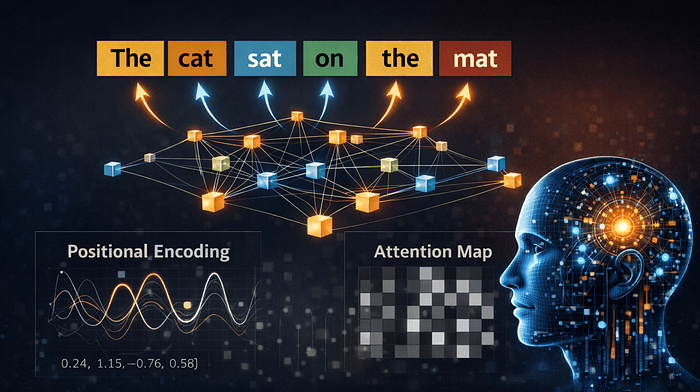
Modern Transformers use positional encoding to teach AI the importance of word order. This innovation differentiates AI models like BERT and GPT, proving essential for understanding complex language structures.
AI understanding language, word order changes everything. Imagine 'dog bites man' versus 'man bites dog.' Same words, different meaning. This is where Transformers shine, and it's all thanks to positional encoding.
Why Word Order Matters
AI, especially for language models, not knowing word order is like trying to read a book with the pages shuffled. Older models like RNNs and LSTMs handled this by processing words sequentially. Slow and steady. But Transformers? They process everything at once. Fast, but initially blind to sequence.
Without intervention, a Transformer might think 'the cat sat on the mat' is the same as 'the mat sat on the cat.' Clearly, not the same. Enter positional encoding.
The Fix: Positional Encoding
The solution seems almost too simple: add a position vector to each word's embedding. Now, the position of 'cat' at spot two isn't the same as 'cat' at spot five. This tweak is what allows Transformers to distinguish between our earlier cat and mat situation.
The original approach from the 'Attention Is All You Need' paper used sine and cosine waves to encode these positions. Picture it: each word gets a unique 'wave' pattern, like a fingerprint that marks its spot in the sentence.
Why Sine and Cosine?
Why go for waves? They're mathematically elegant. Each wave pattern is unique, making it easy for the model to differentiate between positions. The real kicker? It can even recognize the distance between words, whether they're close together or miles apart in the sentence.
But let's get bold here. While sinusoidal encoding is a neat trick, modern models like BERT and GPT have moved on. They use learned positional embeddings, optimizing these during training. It's more adaptable, fitting the nuances of specific data. Yet, I can't help but think: will sacrificing the mathematical elegance of sine waves one day come back to bite us?
Final Thoughts
So, why should this matter to you? If AI can't handle word order, it's like a GPS without directions. Understanding language isn't just about knowing words, but knowing how they fit together. Positional encoding is the glue that makes it possible for models to understand our chaotic, wonderful human language.
With AI growing faster than ever, the question isn't if positional encoding matters, it's how far it'll take us. Solana doesn't wait for permission, and neither does the future of AI.
Get AI news in your inbox
Daily digest of what matters in AI.