The NHS Crisis: Numbers Don't Lie
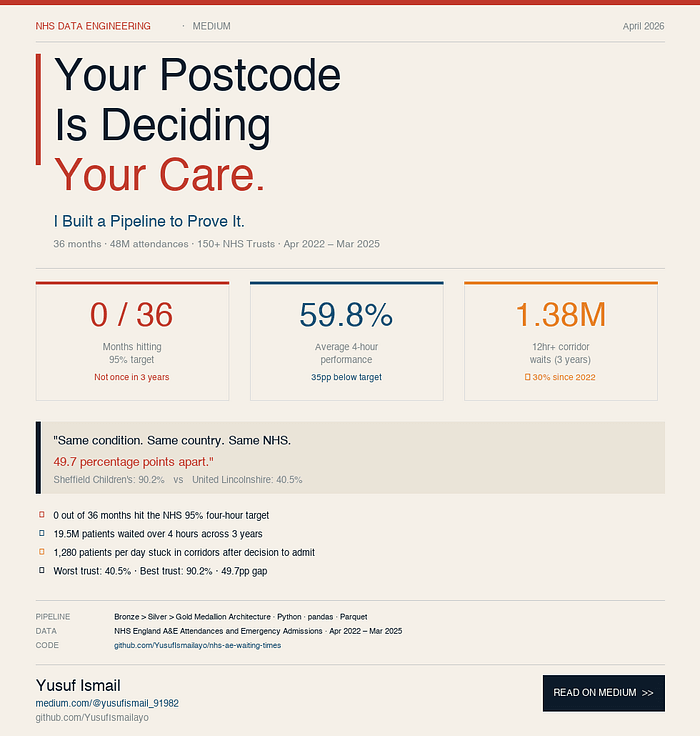
The NHS faces a stark reality: a system unable to meet its own targets. With millions waiting beyond promised times, the data reveals a troubling trend.
Imagine waiting in a hospital corridor at 2 a.m., a doctor has decided you need a bed, yet you're still in limbo. That's not an outlier. It's a Tuesday in the NHS.
The Data Speaks
I've been analyzing NHS performance data for months, focusing on outpatient records and A&E waiting times. The chart tells the story: 1,280 patients daily find themselves in corridors, waiting long after a doctor has decided on their admission. This isn't a system under strain. It's one that's accepted what should be unacceptable.
The NHS has a target dating back to 2000: 95% of A&E patients should be seen, treated, and either admitted or discharged within four hours. Yet, over 36 months from April 2022 to March 2025, not once did the system hit that target. The best monthly performance was a mere 65.5% in April 2023. December 2023 saw the worst at 54.3%. On average, the NHS falls 35 percentage points below its target.
Stuck in Corridors
Beyond the four-hour benchmark lies another, more harrowing statistic: the 12-hour waits. These are instances where patients remain in corridors even after a decision to admit. In three years, 1,381,891 people endured this. It's a trend that’s worsening. From 410,029 waits in 2022/23 to 532,451 in 2024/25, a 30% increase. December consistently records the highest numbers, as if winter's arrival is an unexpected guest.
Visualize this: monthly 12-hour waits after decision to admit, by region. The numbers only get more concerning over time.
A Postcode Lottery
Your location determines your NHS experience. My analysis reveals stark differences. The South East averages 63.9% on the four-hour target, while the North West lags at 55.2%. But dig deeper into trust-level data. Sheffield Children’s NHS Trust averages 90.2%, contrasting sharply with United Lincolnshire at 40.5%. Same NHS, vastly different outcomes based solely on geography. That's a gap too wide to ignore.
I live in Telford, served by Shrewsbury and Telford Hospital NHS Trust. It ranks third worst in England with a 43.6% average four-hour performance. Monthly, 825 patients wait over 12 hours post-admission decision. The trend is clearer when you see it: proximity doesn't guarantee care efficiency.
This data isn't a critique of NHS staff but a call to reevaluate systemic priorities. If winter is predictable, why isn’t the system better prepared? The numbers in context reveal an urgent need for action.
Get AI news in your inbox
Daily digest of what matters in AI.