Sanctuary AI’s robotic hand demonstrates zero-shot in-hand manipulation

Sanctuary AI said its robotic hand and AI system achieved the target orientation 10 times in a row without dropping the cube. The post Sanctuary AI’s robotic hand demonstrates zero-shot in-hand manipulation appeared first on The Robot Report.
Sanctuary AI this week demonstrated its approach to training dexterous manipulation policies for its robotic hands. In its latest video, the company’s hydraulic hand autonomously manipulated a lettered cube, continuously reorienting it to match a specified goal.
The system successfully achieved the target orientation 10 consecutive times without dropping the cube, highlighting robust in-hand manipulation capabilities.
The manipulation takes place entirely at the fingertips without the support of the palm, requiring the hand to simultaneously and stably grasp the object, while making progress towards the orientation goal. Such capabilities form the foundation for precise insertion, tool use, and other real-world dexterous tasks, said Sanctuary AI.
Degrees of freedom, hydraulic actuation make a difference
Sanctuary AI claimed that the high number of degrees of freedom in its proprietary robotic hands enable finger abduction and sophisticated in-hand manipulation that most current robotic hands cannot do.
The Vancouver, B.C.-based company also uses hydraulic actuation, which it said provides increased strength, speed, and control.
Combined with compact hydraulic valves, this advancement offers a promising path toward achieving human-level dexterity for industrial applications, Sanctuary AI asserted.
Founded in 2018, Sanctuary Cognitive Systems Corp. said it has been recognized a leader in intellectual property around general-purpose robots and embodied artificial intelligence. In 2023, the company unveiled its Phoenix humanoid robot.
Editor’s note: At the 2026 Robotics Summit & Expo on May 27 and 28 in Boston, there will be sessions on embodied and physical AI, as well as on humanoid robot development. Registration is now open.

Sanctuary AI tackles a notoriously difficult challenge in robotics
In-hand manipulation itself is a notoriously difficult problem in robotics, noted Sanctuary AI. The ability to repeatedly reorient a cube without failure underscores both the effectiveness of the learned policy and the capability of the underlying hardware, it said.
The goal of this experiment was straightforward but demanding: Demonstrate that a simulation-trained policy can reliably transfer to the real world and repeatedly achieve a target object orientation.
With this demonstration, Sanctuary AI said it showcases a successful instance of zero-shot transfer: a policy trained entirely in simulation performs seamlessly in the real world. This level of transfer fidelity indicates that the simulation environment accurately captures real-world dynamics while producing robust policies, it said.
Simulating anthropomorphic hands remains a significant challenge due to their complexity, contact dynamics, and high degrees of freedom, acknowledged Sanctuary AI. The company said the success of this transfer highlighted its ability to build highly realistic training environments.
In addition to its robot hands and Phoenix, Sanctuary AI offers Carbon, its AI control system. It said Carbon mimics subsystems found in the human brain, such as memory, sight, sound, and touch.
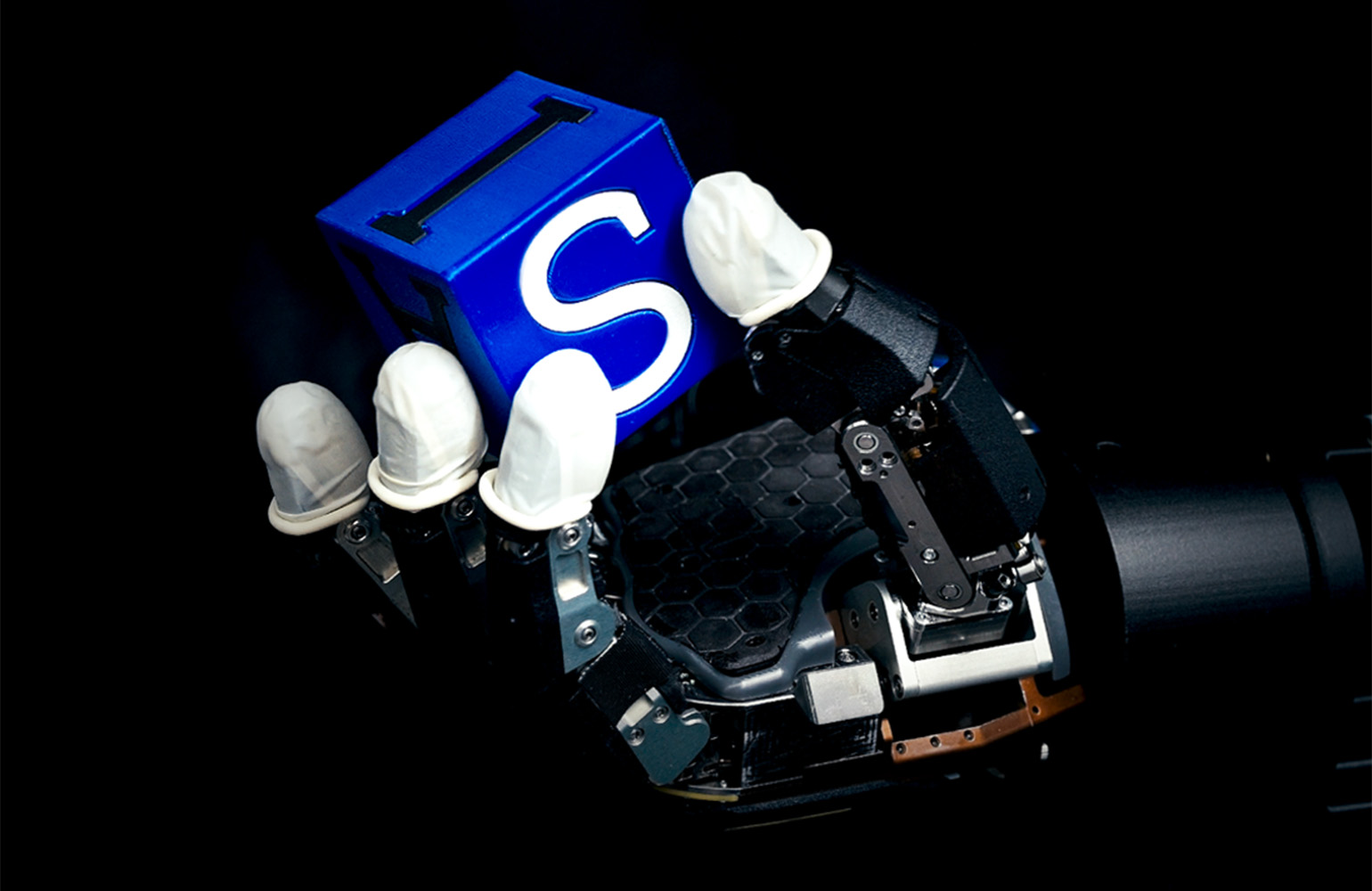
Sanctuary AI’s robotic hand has 21-degrees-of-freedom. | Source: Sanctuary AI
The post Sanctuary AI’s robotic hand demonstrates zero-shot in-hand manipulation appeared first on The Robot Report.
Get AI news in your inbox
Daily digest of what matters in AI.
Key Terms Explained
The science of creating machines that can perform tasks requiring human-like intelligence — reasoning, learning, perception, language understanding, and decision-making.
The ability of AI models to interact with external tools and systems — browsing the web, running code, querying APIs, reading files.
The process of teaching an AI model by exposing it to data and adjusting its parameters to minimize errors.