Runtime Reinforcement: Preventing “Instruction Decay” in Long Context Windows
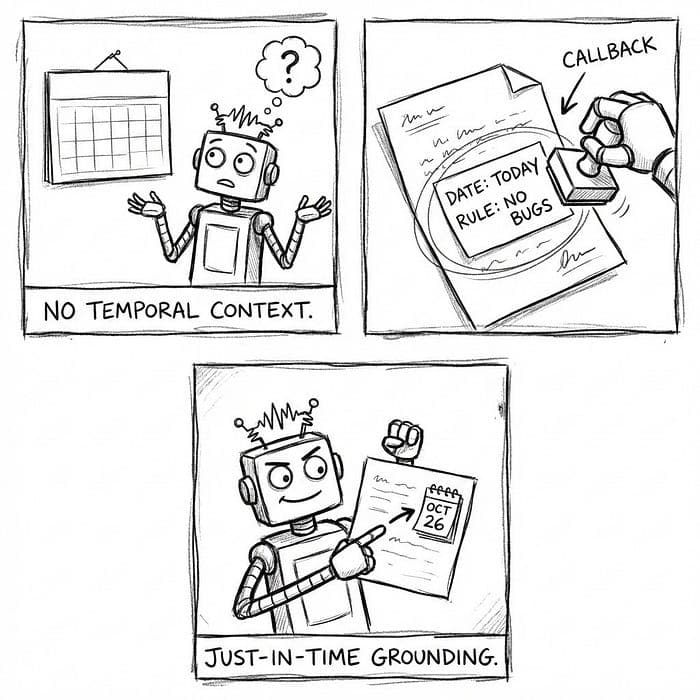
Author(s): Shreyash Shukla Originally published on Towards AI. Image Source: Google Gemini The “Floating Brain” Problem In our previous articles, we discussed how to give the agent knowledge (Graph), sight (Shape), and empathy (User Context). But even a perfect agent suffers from a fundamental flaw inherent to the Large Language Model architecture: it exists in a timeless void. An LLM has no internal clock. It does not know that “today” is Tuesday. Furthermore, as a conversation progresses, it suffers from “Context Drift.” Research from Stanford (Liu et al., 2023) has quantified a behavior known as the “Lost in the Middle” phenomenon. As the context window fills up with conversation history (SQL queries, data tables, user chit-chat), the model’s attention mechanism begins to degrade. It prioritizes the very beginning (System Prompt) and the very end (User’s latest question), but the critical instructions in the middle — like negative constraints (“Do not use the eng_rate metric")—often get ignored [Lost in the Middle: How Language Models Use Long Contexts – arXiv]. We call this “Instruction Decay.” Temporal Failure: A user asks, “How is performance this week?” The agent, lacking a reference for “this week,” hallucinates a date range or defaults to a training data timestamp. Compliance Failure: In Turn #1, the agent remembers to “Exclude Returns & Allowances.” By Turn #20, after processing 50,000 tokens of other data, that specific instruction is “washed out” by Recency Bias [Instruction Following in LLMs — MIT Press]. We cannot rely on the static System Prompt to hold the line forever. We need a Runtime Interceptor — a “Just-in-Time” layer that stamps the current time and non-negotiable business rules onto the very end of the prompt context, milliseconds before the model generates a response. Temporal Grounding (The “When”) To an LLM, “Time” is a frozen concept. It knows that World War II ended in 1945, but it does not know if “last quarter” refers to Q4 2023 or Q1 2024. This is because the model’s internal state is static, defined by its training cutoff. When a user asks, “Show me sales for the last 7 days,” a standard agent might either: Hallucinate: Guess a date range based on example prompts it saw during training. Fail: Refuse to answer due to ambiguity. To fix this, we must anchor the agent in the Present Moment. We do this by injecting a precise, timezone-aware timestamp into the prompt context at the exact moment of inference. We can utilize the before_model_callback to generate a dynamic header. Using datetime , we append a timestamp prefix to every user turn ensuring that "today" aligns with the user's definition of "today." import datetimeimport pytzdef get_temporal_context(): # 1. Define the Corporate Timezone (Critical for Data Alignment) # If your DB is in UTC, this must be UTC. If PST, use PST. target_tz = pytz.timezone("America/Los_Angeles") # 2. Get the specific "Now" current_time = datetime.datetime.now(target_tz).strftime( "%Y-%m-%d %H:%M:%S %Z" ) # 3. Format as a System Directive return f"[Timestamp]: The current date and time is {current_time}." When the user types “How is performance?”, the callback silently prepends this string. The LLM receives: [Timestamp]: The current date and time is 2025-10-27 14:30:00 PDT. User: How is performance? The model now possesses the necessary variable to calculate relative dates. It automatically interprets “performance” as “performance as of Oct 27th,” resolving the ambiguity without a single follow-up question. Image Source: Google Gemini Critical Reinforcement (The “What”) In a perfect world, an LLM would read your System Prompt once and remember it forever. In reality, LLMs suffer from the “Recency Effect.” They pay disproportionate attention to the last few user messages and often “forget” constraints buried 10,000 tokens back in the history. This is dangerous for enterprise data. If the model forgets to “Exclude Internal Test Accounts” because it got distracted by a long conversation about revenue, the resulting SQL is technically valid but business-wrong. The Solution: The “Sticky Note” Pattern We treat the before_model_callback as a mechanism to slap a "Sticky Note" onto the user's prompt right before it enters the model's brain. This is Active Governance. The Engineering: The Reinforcement Block We construct a string block containing only the most critical, high-failure-rate instructions. We append this block to the end of the prompt, ensuring it is the fresh context the model sees. What Goes Inside? (Universal Patterns) We focus on two categories of failure modes common across all LLMs (GPT-4, Claude, Gemini, Llama): Hard Business Logic (The “Musts”): Rules that, if missed, cause compliance or accuracy issues. Example: “MANDATORY: When calculating ‘Active Users’, you MUST exclude any user_id starting with ‘test_’.” Why here? Because test data looks just like real data. The model will include it unless explicitly warned at runtime. Syntactic Hallucination (The “How”): Complex technical syntax that models often fumble when dealing with nested data types. Example (JSON/NoSQL): “REMINDER: When querying the properties column, do not assume keys exist. Always use JSON_EXTRACT(properties, '$.region') instead of properties.region." The Fix: We inject a snippet forcing the safer, explicitly verbose syntax to prevent runtime errors. The Resulting Prompt Structure The LLM sees a composite prompt: [System Prompt] (The general persona) [Conversation History] (The last 20 turns) [User Input] ("Show me the numbers.") [Runtime Injection] ("Timestamp: 10:00 AM. Rule: Exclude 'test_%'. Syntax: Use JSON_EXTRACT.") By physically placing the rules after the user input, we mathematically increase the probability of adherence. Image Source: Google Gemini The Code Artifact (The Implementation) We have the theory (Recency Bias) and the strategy (Sticky Note). Now we need the code. The following Python class demonstrates how to implement a Runtime Interceptor. It uses a standard callback pattern to intercept the llm_request object, generate the reinforcement block, and append it to the prompt stream before the model ever sees it. The Code Walkthrough This ImprovePrompt class performs three critical actions: Time Stamping: It calculates the current time in the business’s primary timezone (e.g., PST/EST), ensuring the model knows “when” it is. Rule Aggregation: It defines a dictionary of non-negotiable rules (Syntax & Logic). Prompt Surgery: It physically […]
This article was originally published by Towards AI. View original article
Get AI news in your inbox
Daily digest of what matters in AI.
Key Terms Explained
A mechanism that lets neural networks focus on the most relevant parts of their input when producing output.
The attention mechanism is a technique that lets neural networks focus on the most relevant parts of their input when producing output.
In AI, bias has two meanings.
Anthropic's family of AI assistants, including Claude Haiku, Sonnet, and Opus.