RoboCup 2025: The Future of Robotics Beyond the Pitch
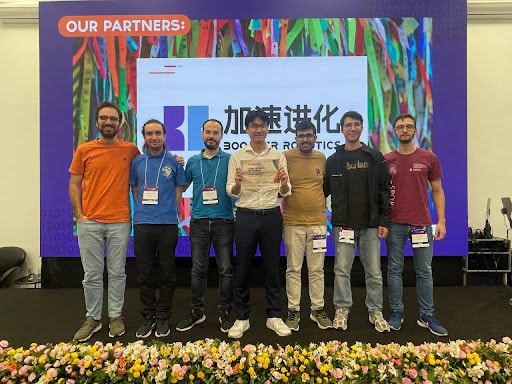
The SPQR team’s award-winning research at RoboCup 2025 pushes the boundaries of autonomous soccer-playing robots. Their innovative approach to ball detection signals a shift towards broader AI applications.
The RoboCup 2025 in Salvador, Brazil, saw the SPQR team from Rome clinching the best paper award, a testament to their groundbreaking work in autonomous robotics. At the heart of their research lies the challenge of accurate ball detection, a problem essential not just for soccer-playing robots but for broader AI applications.
Revolutionizing Ball Detection
Daniele Affinita and his team tackled the labor-intensive process of manually labeling data for deep learning. They introduced a self-supervised learning framework that reduces human effort by allowing robots to learn from unlabeled data. This approach, enriched by external guidance from a larger model, marks a significant leap forward in AI efficiency.
Why does this matter? Imagine deploying such technology in industries beyond soccer. The potential to detect and analyze objects in various environments, from farming to factory floors, could redefine productivity and precision in these fields. The Gulf is writing checks that Silicon Valley can't match, and SPQR's innovations might soon find backing where the dirham flows freely.
From the Pitch to the Farm
The SPQR team isn't stopping at soccer. They've already begun exploring how their ball detection method could revolutionize precision farming. By adapting their algorithms, they aim to detect and harvest rounded fruits, illustrating a perfect example of technology transfer from sports to agriculture.
Is this the future of robotics? If a robot can adapt from playing a game to plucking a fruit, the possibilities are endless. The corridor from the RoboCup to real-world applications is shorter than we might think, and SPQR is leading the way.
Challenges and Future Directions
As RoboCup evolves, so do the ambitions of the SPQR team. They face a changing landscape with new league mergers and technological advances. Yet, their commitment to innovation remains unshaken. Their work not only attracts the best minds but ensures a continuous flow of fresh ideas and talent.
In a world where winning is often the ultimate goal, SPQR seeks something more profound: the fusion of competition and research. They're not just preparing for the next RoboCup but for a future where robots might even challenge football's greatest. Between VARA and ADGM, the licensing landscape is more nuanced than it appears, and SPQR is poised to navigate it brilliantly.
Get AI news in your inbox
Daily digest of what matters in AI.
Key Terms Explained
A subset of machine learning that uses neural networks with many layers (hence 'deep') to learn complex patterns from large amounts of data.
A training approach where the model creates its own labels from the data itself.
The most common machine learning approach: training a model on labeled data where each example comes with the correct answer.