Rice University's Soft Robotics: Shedding Wires for Laser Precision
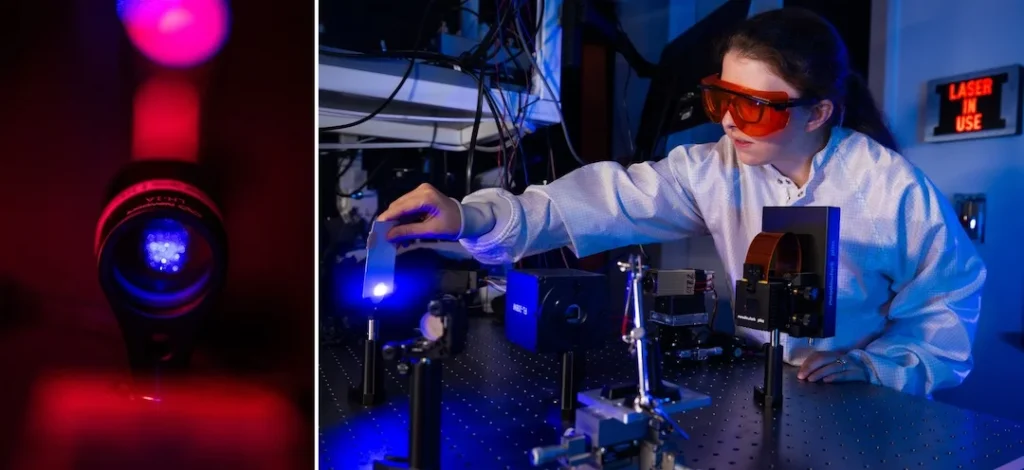
Rice University has unveiled a wire-free soft robotic arm, guided by lasers and AI, signaling a leap in surgical and industrial applications.
Rice University researchers have taken a bold step in robotics. They've engineered a soft robotic arm that operates without onboard electronics, guided entirely by laser beams. This innovation not only sidesteps traditional wiring but also promises new possibilities for surgical devices and industrial machinery handling fragile items.
Light-Controlled Motion
Led by materials scientist Hanyu Zhu, the team at Rice employed azobenzene liquid crystal elastomer, a polymer that reacts to light. By coupling this with a neural network, the researchers achieved real-time, programmable movements in the robotic arm. This neural network predicts the precise light patterns required, enabling complex tasks without intricate user input.
Elizabeth Blackert, a key member of the team, emphasized the significance: "This was the first demonstration of real-time, reconfigurable, automated control over a light-responsive material for a soft robotic arm." The research, detailed in Advanced Intelligent Systems, opens doors to more flexible robotic applications.
Beyond Traditional Robotics
Conventional robots are confined by their rigid structures. Soft robotics, however, with their continuum designs, offer a much broader range of motion. The challenge, as Zhu noted, lies in overcoming the tethering and limited functionality of previous soft materials. This project, blending materials science, optical systems, and machine learning, tackles that challenge head-on.
The team developed an elastomer variant that contracts under blue laser light and relaxes in the dark, enabling swift resetting. Other light-reactive materials either require harmful UV light or are slow to respond, making this an impressive leap forward.
Infinite Degrees of Freedom
The use of a spatial light modulator allows a single laser beam to be split into multiple, directed beamlets. Each beamlet can be individually modulated, granting the arm an almost limitless range of motion. If traditional robots struggle with fixed joints, this innovation mirrors the fluidity of octopus tentacles.
Rafael Verduzco, another key figure in the study, highlighted the uniqueness: "Using the light pattern to achieve complex changes in shape is what's new here." This isn't just a theoretical improvement. It's a practical leap that could redefine the capabilities of robotics in sensitive environments.
Currently, the prototype operates in two dimensions, but future iterations could introduce three-dimensional movements with added sensors. Imagine what this could mean for medical devices navigating delicate tissues or robots in factories handling soft goods. Is this the dawn of a new era in robotics? Quite possibly.
Get AI news in your inbox
Daily digest of what matters in AI.