Rethinking Reinforcement Learning: The Divide and Conquer Approach
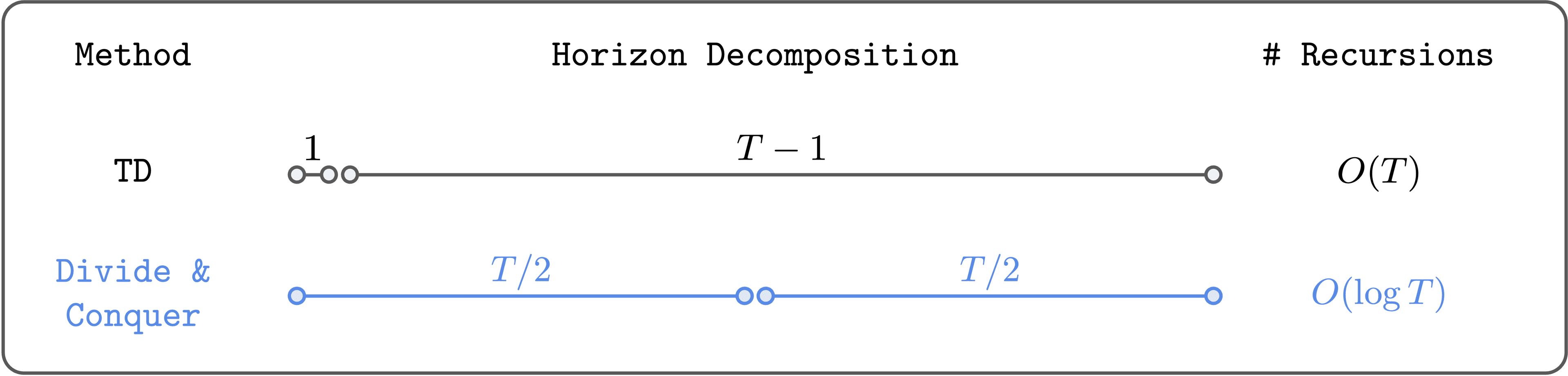
Berkeley's AI research introduces a novel off-policy reinforcement learning strategy that moves beyond traditional temporal difference learning. This 'divide and conquer' method could reshape how we approach long-horizon tasks in AI.
Traditional reinforcement learning (RL) has long relied on temporal difference (TD) learning, but a fresh perspective is emerging from Berkeley AI Research. This new method, termed 'divide and conquer,' offers a promising alternative for tackling long-horizon tasks without the scalability issues associated with TD learning.
Off-Policy RL: The Challenge
Off-policy RL is a flexible yet challenging domain because it allows the use of various data types, including historical data and simulations. This flexibility is particularly key in sectors like robotics and healthcare, where collecting new data can be both expensive and time-consuming. While on-policy methods like PPO and GRPO have matured, off-policy RL has struggled with scalability in complex tasks.
The core issue lies in the error propagation through the Bellman update rule, where errors at one time step bootstrap into future steps, complicating long-horizon task handling. Current solutions, such as mixing TD with Monte Carlo (MC) methods, alleviate some issues but don't fundamentally solve error accumulation. They also require fine-tuning the hyperparameter 'n,' a task-specific endeavor.
The Divide and Conquer Solution
Berkeley's divide and conquer approach offers a new solution by breaking down tasks into smaller, manageable segments and combining their values to update the complete trajectory. This reduces the number of Bellman recursions logarithmically rather than linearly, eliminating the dependency on a hyperparameter like 'n.'
Transitive RL (TRL), a practical implementation of this idea, has shown promise in goal-conditioned RL tasks. By dividing trajectories into two parts, TRL uses expectile regression to optimize subgoals within a dataset's trajectory, preventing overestimation and allowing for scalable training in complex environments.
Performance and Future Directions
TRL's performance on tasks from the OGBench benchmark, such as humanoidmaze and puzzle, has been impressive. It matches or exceeds the performance of TD-n methods without needing to adjust 'n.' The chart tells the story: TRL is a breakthrough for handling long-horizon tasks effectively.
Yet, questions remain. Can TRL be adapted for regular, reward-based RL tasks? How will it handle stochastic environments that introduce uncertainty? The potential of divide and conquer is clear, but the path to a scalable off-policy RL algorithm continues to evolve.
Berkeley's approach doesn't just address a technical challenge. it reshapes our understanding of decision-making in AI. As researchers refine TRL and explore its applications, one wonders if this could be the key to unlocking reliable, scalable AI systems in the future.
Get AI news in your inbox
Daily digest of what matters in AI.
Key Terms Explained
A standardized test used to measure and compare AI model performance.
The process of taking a pre-trained model and continuing to train it on a smaller, specific dataset to adapt it for a particular task or domain.
A setting you choose before training begins, as opposed to parameters the model learns during training.
A machine learning task where the model predicts a continuous numerical value.