Redefining Companies: The Self-Improving AI Loop
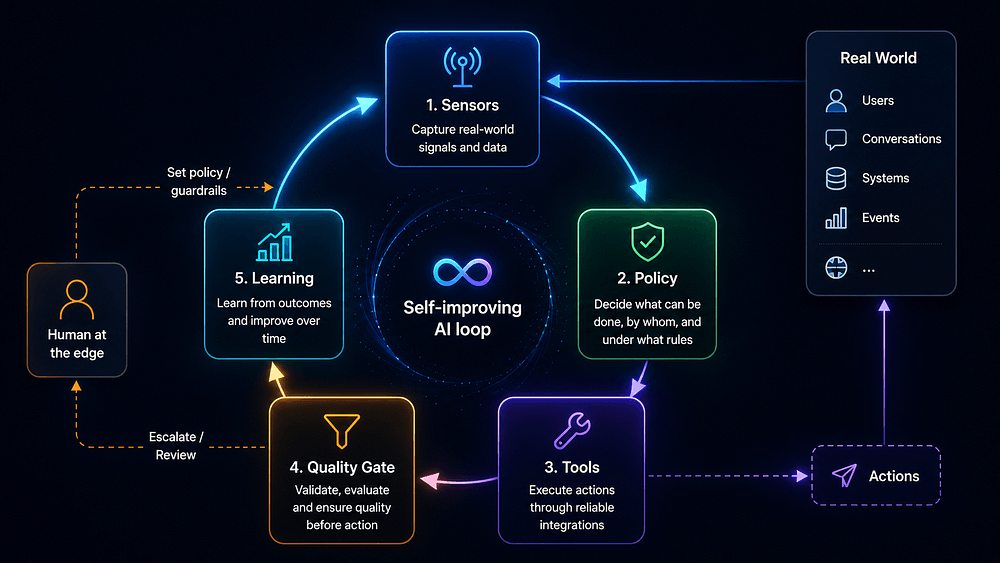
Most companies still rely on outdated hierarchies, but a new approach suggests companies should function as self-improving AI loops, maximizing efficiency and minimizing human intervention.
Modern companies are grappling with the integration of AI into their traditional frameworks, often treating it as an afterthought rather than a fundamental change in how they operate. The prevailing notion of simply bolting AI onto existing company structures is akin to installing a jet engine on a horse-drawn carriage. It might add some speed, but it doesn't revolutionize the journey.
From Hierarchies to Loops
Tom Blomfield, the co-founder of Monzo and a General Partner at Y Combinator, argues for a transformative approach. He suggests companies should be viewed as a series of recursive, self-improving AI loops. These loops have the potential to evolve and enhance themselves with minimal human oversight, effectively allowing the system to improve autonomously overnight.
The structure comprises five layers: the sensory input layer, decision-making policies, the execution through specific tools, quality control checks, and a learning mechanism. The aim is to record everything, making the company legible to AI. As a result, the system becomes more efficient, shifting the focus from human headcount to the optimization of AI capabilities.
The Holy Grail of Automation
The concept of a self-improving loop was put to the test at Y Combinator through a simple internal tool. This tool not only answered queries but also monitored its own success and failure rates. When failures occurred, the AI identified the gap, made corrections, and executed code changes without human intervention. The result? Questions that failed one day were answered correctly the next, all thanks to the AI's ability to adapt and learn independently.
This scenario is illustrative of the potential for AI to do more than augment human capacity. It can, in fact, lead to a business model where AI loops not only supplement human effort but also redefine organizational productivity altogether.
Implications for Developers and Founders
For developers and startup founders, the lesson is clear. The future belongs to those willing to redesign companies not as hierarchical entities but as dynamic, recursive systems. What remains to be pondered is: Will the shift from headcount to AI-driven processes lead to a more efficient way of operating, or will it marginalize the human role to mere oversight?
The reserve composition matters more than the peg. In this context, organizations must consider how they balance their human resources with AI capabilities. Ultimately, the companies that embrace these loops will likely stand at the forefront of innovation, prepared to tackle challenges with a system that evolves even while they sleep.
Get AI news in your inbox
Daily digest of what matters in AI.