PhAIL's New Leaderboard: A Reality Check for Robotics AI
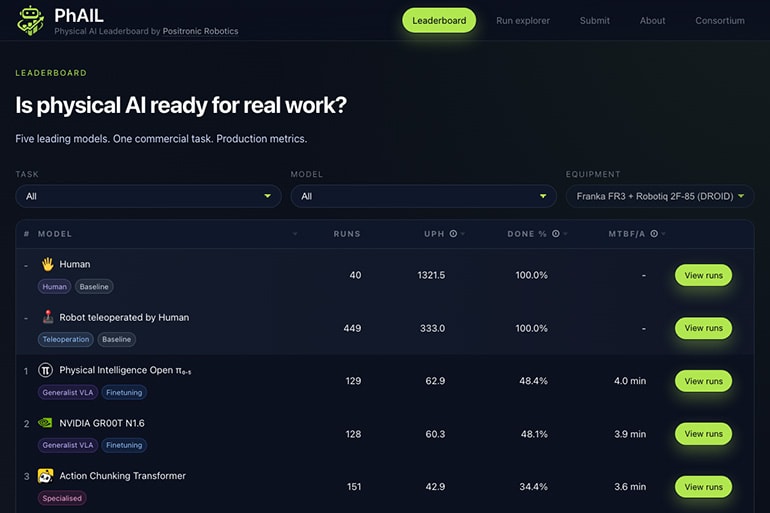
Positronic Robotics has launched the Physical AI Leaderboard (PhAIL) to evaluate AI models on real-world tasks using actual hardware, beginning with bin-to-bin order picking. This initiative addresses the gap between impressive AI demos and their practical deployment.
Positronic Robotics recently unveiled its Physical AI Leaderboard, or PhAIL, aiming to bring some much-needed reality to the world of robotics AI. Founded in September 2025, this Missouri-based company wants to bridge the gap between flashy research models and actual robotic production by evaluating AI models on real hardware. Their first task? The humble yet critical bin-to-bin order picking.
Why PhAIL Matters
In the industry, the real test is always the edge cases, and that's exactly where PhAIL steps in. By using a Franka Research 3 robotic arm and a Robotiq 2F-85 gripper, PhAIL evaluates how AI models perform in the nitty-gritty of logistics and industrial automation. This isn't just about AI that looks good on paper. It's about AI that actually works when the rubber meets the road.
PhAIL's approach is straightforward. It measures throughput and reliability, two metrics that any operations manager would care about. Forget about academic success rates. We're talking units per hour and mean time between failures or assists. The demo might be impressive, but the deployment story is messier. PhAIL isn't interested in controlled lab glory. It's tackling real-world chaos head-on.
The Challenge for Robotics AI
During its initial evaluations, PhAIL tested four models, including NVIDIA's GR00T and HuggingFace's SmolVLA, alongside human and teleoperated baselines. Unsurprisingly, there's a noticeable gap between these foundation models and human-level performance. But here's where it gets practical: PhAIL provides a transparent baseline for measuring progress over time. As new models emerge, they'll be evaluated under the same rigorous conditions, creating a continuous record of achievement, or lack thereof.
Positronic's initiative highlights three critical issues: the lack of objective measures for commercial readiness, unclear ROI signals for operators, and a broken feedback loop for model builders. Without standardized benchmarks, it's hard to iterate toward that coveted real-world reliability. So, PhAIL puts its money where its mouth is with auditability and reproducibility, publishing synchronized videos and logs for every test.
The Road Ahead
PhAIL isn't just a pet project. It's a consortium-driven effort, with partners like AI cloud provider Nebius and data partner Toloka. They're treating the benchmark as a shared industry yardstick rather than a marketing ploy. PhAIL's data set and fine-tuning scripts are publicly available, inviting model builders to test their systems and submit for evaluation.
“Scaling physical AI requires a clear, shared standard for production readiness,” says Evan Helda from Nebius. And he's right. Without a standard, how can we truly know what AI is ready for prime time? This initiative could redefine how the industry gauges the maturity of AI systems. So, what could go wrong? In production, this looks different. The real challenge will be in maintaining transparency and objectivity as the leaderboard grows.
Get AI news in your inbox
Daily digest of what matters in AI.
Key Terms Explained
A standardized test used to measure and compare AI model performance.
The process of measuring how well an AI model performs on its intended task.
The process of taking a pre-trained model and continuing to train it on a smaller, specific dataset to adapt it for a particular task or domain.
The dominant provider of AI hardware.