PCA: The Magic Wand of Data Simplification
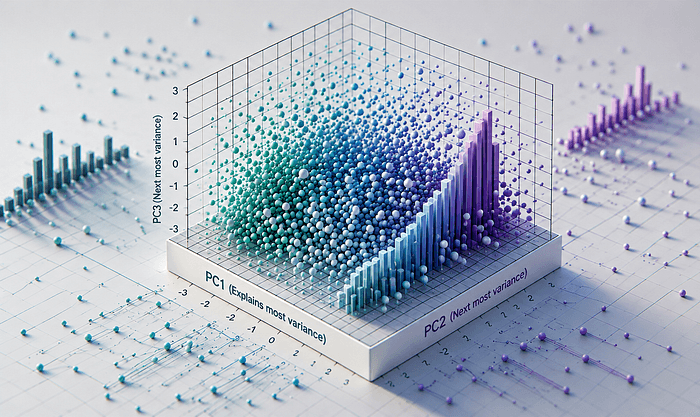
Principal Component Analysis cuts through the noise of high-dimensional data. Transforming complexity into clarity, it's a must-know for data jockeys.
Principal Component Analysis (PCA) isn't just math magic. It's the secret sauce for anyone drowning in data. It takes a tangled mess of correlated variables and distills them into something manageable. How? By transforming correlated variables into a smaller set of uncorrelated ones. No more chasing your tail with redundant data. Think of PCA as the ultimate decluttering tool for your dataset, preserving the stuff that truly matters.
Why PCA Rules
PCA is grounded in solid math. We're talking covariance analysis, orthogonal transformations, and eigenvalue decomposition. Sounds complex, right? But what it does is simple: maximizes variance. With datasets ballooning into hundreds or thousands of variables, especially in fields like finance and machine learning, PCA cuts through the inefficiencies.
Consider a dataset with n observations across p features. They're often correlated, just like height and weight in a population study. The more data you've, the harder it gets to make sense of it all. PCA asks, "Can we see the variability more clearly?" The answer, almost always, is yes.
Geometric Wizardry
Imagine PCA as a geometric wizard. It rotates your data into a new coordinate system, aligning with the natural shape of your data cloud. It’s like turning a photo to catch the best light. For instance, two financial variables like a stock's return and trading volume rarely form a neat pattern. They tend to move together. PCA finds the diagonal stretch and calls it PC₁, the principal component that explains the most variance. PC₂ picks up the slack, capturing what's left at a right angle to PC₁. It’s an elegant dance that simplifies without losing essence.
Here's the kicker: PCA doesn't change the data itself. It changes how you look at it. All your points stay put. Only the rulers, the measurement axes, are rotated. That’s why PCA is lossless when you keep all components. Choose the top few, and you’re making an informed decision to compress, not distort.
The Bottom Line
Why should you care? Because PCA is like a cheat code for making sense of the chaos. If you’re not using it, you’re working harder, not smarter. Another week, another Solana protocol doing what ETH promised, and PCA is the tool making that efficient analysis possible.
In a world where data is the new oil, PCA is the refinery. If you haven't tried it yet, you're missing out. I tested this so you don't have to. Trust me, the speed difference isn't theoretical. You feel it.
Get AI news in your inbox
Daily digest of what matters in AI.