Optimizing LLMs: The Real Bottleneck and How to Fix It
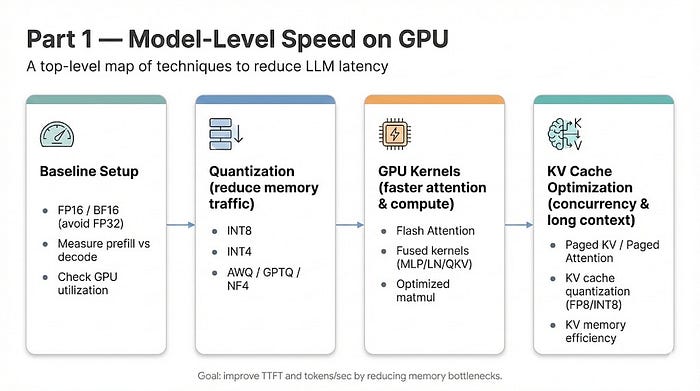
LLM performance isn't just about computing, it's memory-bound. Maximizing efficiency requires a fresh look at GPU arithmetic and memory bandwidth.
In the high-stakes world of deploying large language models (LLMs), speed is king. Yet, many teams stumble at the starting line. The real bottleneck? It's not serving logic or network overhead. It's the raw arithmetic inside the GPU.
The Memory Bandwidth Misconception
There's a widespread belief that LLMs are inherently compute-bound. That's not always true. When decoding, these models hit a wall not of computation, but of memory bandwidth. Consider a 7-billion parameter model operating in FP16. It requires 14 GB for weights alone. To generate a single token, you move these 14 GB through the GPU's memory bandwidth, but only perform around 14 GFLOPs of computation. The arithmetic intensity is shockingly low, about 1 FLOP per byte. Modern GPUs need more than 200 FLOPs per byte to fully engage their tensor cores. This means during decode, you find yourself waiting on high-bandwidth memory (HBM) reads, not matrix multiplications.
Optimization: Quantization and Batching
What does this mean for optimization? Batching is an obvious win. It amortizes the weight loads across multiple sequences, improving memory bandwidth utilization. Quantization also plays a vital role. By reducing weights to INT4, you cut memory needs by a factor of four, directly lowering latency. But there's a trade-off. Quantization can degrade quality, so measure its impact on your specific prompt distribution.
Prefill vs. Decode: A Strategy Shift
The distinction between prefill and decode phases is important. Prefill deals with the entire prompt in one pass, building a key-value (KV) cache that's heavy on compute and memory. Decode, however, generates tokens one at a time, dominated by memory bandwidth as it streams the entire KV cache through HBM on each step. This asymmetry demands a phase-aware approach to optimization. Prefill benefits from better attention kernels like Flash Attention, while decode requires efficient cache management.
A Closer Look at Quantization Techniques
Quantization stands out as a potent model-level optimization. INT8 quantization shows minimal perplexity loss, typically under 0.1%. Implementation is straightforward with tools like bitsandbytes. Yet, the real magic happens with INT4. This level of compression offers a 2-3x latency boost, although not without measurable quality degradation. Always validate this with your actual data.
Activation-Aware Weight Quantization (AWQ) refines this further by recognizing that not all weights are equally essential. By focusing on activation magnitudes, AWQ outperforms naive quantization in accuracy. Meanwhile, Gradient-Based Post-Training Quantization (GPTQ) uses second-order information to minimize quantization error, producing excellent 4-bit models.
Why This Matters
Why should you care? Because in the race to deploy ever-larger models, understanding these bottlenecks can mean the difference between a product that impresses and one that lags. Visualize this: by optimizing memory bandwidth and leveraging advanced quantization techniques, you save resources and time, outpacing the competition. So, here's the question: Are you ready to rethink your approach to LLM deployment?
Get AI news in your inbox
Daily digest of what matters in AI.
Key Terms Explained
A mechanism that lets neural networks focus on the most relevant parts of their input when producing output.
The processing power needed to train and run AI models.
An optimized attention algorithm that's mathematically equivalent to standard attention but runs much faster and uses less GPU memory.
Graphics Processing Unit.