NVIDIA's Bold Play in Robotics: A New Era of Physical AI
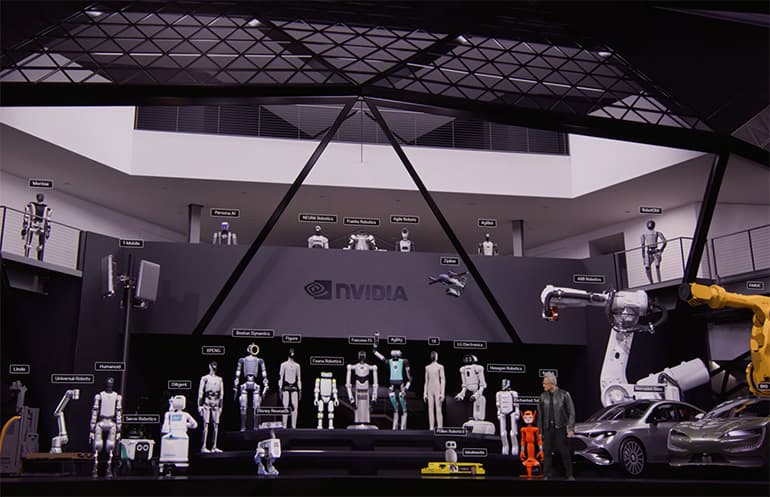
NVIDIA's recent showcase at GTC 2026 underscores its ambition to be a linchpin in the robotics industry, partnering with global leaders to advance AI-driven robotics. Are we witnessing the dawn of a new industrial revolution?
NVIDIA's vision for the future of robotics took center stage at the GPU Technology Conference 2026, where the tech giant unveiled its partnerships with over 110 robot brain developers and industry leaders. This isn't just another tech announcement. it's a strategic move to redefine the robotics landscape with a focus on 'production-scale physical AI.'
Breaking New Ground with Isaac and Cosmos
The unveiling of NVIDIA's Isaac simulation frameworks and Cosmos models marks a key moment for the industry. With partners like ABB Robotics and Agility, NVIDIA is pushing the envelope on what robots can achieve. These tools are designed to train, deploy, and elevate intelligent robots to handle complex tasks with minimal retraining. But here's the kicker: NVIDIA is laying the groundwork for robots that can think and act autonomously.
What does this mean for manufacturers? It signifies a shift towards a future where every industrial company must integrate robotics into its core. It's no longer a question of if, but when. The Gulf is writing checks that Silicon Valley can't match, but NVIDIA's ambitions might just be the bridge between tech hubs.
Simulation: The New Reality
Simulation technology, according to NVIDIA, is where the real magic happens. With industrial giants like FANUC and KUKA integrating NVIDIA Omniverse, the goal is to create digital twins that can validate complex robot applications. This isn't just about fine-tuning machines. it's about revolutionizing how we think about production lines.
Rev Lebaredian, NVIDIA's vice president of Omniverse, stated that the physical AI factory blueprint could shorten training times from years to months. It's a bold claim, but what if it's true? We might be on the cusp of a new industrial era where AI-driven robots simplify logistics, transportation, and more.
Humanoids and Healthcare: The Next Challenge
The development of humanoid robots is perhaps the most ambitious frontier for NVIDIA. Companies like Boston Dynamics and NEURA Robotics are already testing the waters with NVIDIA's frameworks. The integration of Cosmos world models and Isaac simulation aims to bring human-like reasoning and dexterity to machines. Could these robots eventually replace human labor in hazardous or mundane tasks?
The healthcare sector is also a focus, with companies like CMR Surgical using NVIDIA's technology to revolutionize surgical robotics. Imagine a world where surgeries are performed with precision and minimal human error, thanks to advanced AI.
NVIDIA's commitment to making physical AI tools accessible to startups and global innovators through programs like NVIDIA Inception is a testament to its ambition. By partnering with platforms like Hugging Face, NVIDIA is paving the way for a collaborative future in robotics.
As the landscape evolves, one question remains: how long before every factory floor, hospital, and construction site is buzzing with NVIDIA-powered robots? Between VARA and ADGM, the licensing landscape is more nuanced than it appears, but NVIDIA might just be the catalyst that simplifies it all.
Get AI news in your inbox
Daily digest of what matters in AI.
Key Terms Explained
The process of taking a pre-trained model and continuing to train it on a smaller, specific dataset to adapt it for a particular task or domain.
Graphics Processing Unit.
The leading platform for sharing and collaborating on AI models, datasets, and applications.
The dominant provider of AI hardware.