NIST's New Benchmark: A Game Changer for Humanoid Robots?
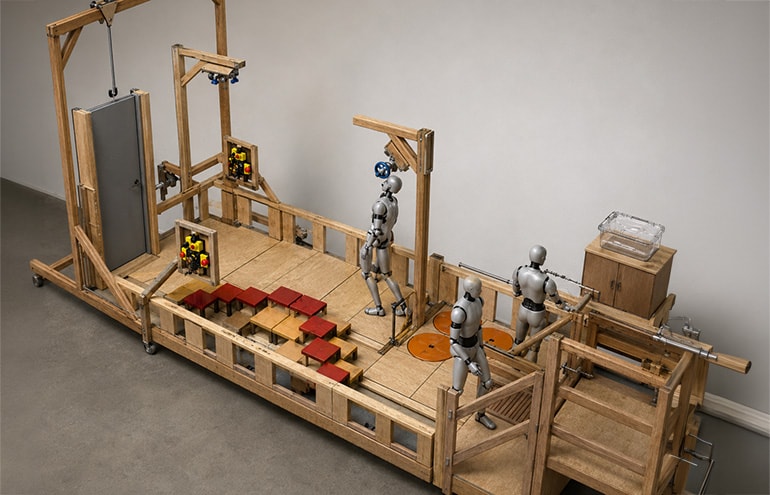
NIST introduces a standardized benchmark for evaluating humanoid robots, aiming to provide clarity in a field dominated by marketing claims. This could redefine the industry's approach to robotic capabilities.
The National Institute for Standards and Technology (NIST) has unveiled a new proposal that could reshape humanoid robotics. By establishing the first standardized performance benchmark since the 2015 DARPA Robotics Challenge, NIST aims to provide a clear framework to evaluate the capabilities of humanoid robots. This comes at a essential moment as the industry sees billions in investment, yet lacks a unified measure of what these robots can truly achieve.
The Need for Standardization
In the past decade, we've witnessed a boom in humanoid robot development, with companies like Tesla, Agility Robotics, and others attracting significant funding. However, the absence of a standardized evaluation method has left a void filled only by glossy marketing videos. NIST's proposal seeks to fill this gap by offering a comprehensive method to assess the minimum expected physical capabilities of these robots.
The initiative builds on NIST's prior collaborations with the Defense Advanced Research Projects Agency (DARPA), aiming to guide future developments and foster a consensus within both the industry and academia., as it sets the stage for a more objective understanding of humanoid robot abilities.
What the Benchmark Entails
NIST's proposed benchmark focuses on locomotion and manipulation tasks, using predefined and standardized methods. The tasks are designed to evaluate basic mobility and manipulation, combining these abilities to test whole-body awareness and control in confined spaces. The goal is to establish a baseline for performance across various domains, from industrial to healthcare applications.
While NIST's approach seems promising, the question remains: will these tasks truly capture the full spectrum of humanoid capabilities? whether this benchmark will become the industry's gold standard, or if it will be just another fleeting measure.
Collaboration and Future Prospects
NIST has developed this benchmark in collaboration with industry experts, inviting further participation to refine the tasks included. The institute plans to distribute a limited number of testing apparatuses to U.S. manufacturers and testing facilities, illustrating its commitment to transparency and collective advancement.
NIST intends to publish the design and 3D models of the apparatus, enabling broader access for training and development. Manufacturers who participate can test their robots under controlled conditions, contributing to a growing dataset that highlights the current state of humanoid robotics.
As the industry continues to evolve, NIST's benchmark could serve as a foundational tool for measuring progress and setting new standards. Will this lead to a renaissance in humanoid robotics, or will it falter under the weight of unfulfilled expectations? Only time, and rigorous testing, will tell.
Get AI news in your inbox
Daily digest of what matters in AI.
Key Terms Explained
A standardized test used to measure and compare AI model performance.
The process of measuring how well an AI model performs on its intended task.
The process of teaching an AI model by exposing it to data and adjusting its parameters to minimize errors.
A numerical value in a neural network that determines the strength of the connection between neurons.