MiniMax M3: A Game Changer for Long-Context AI at Bargain Prices
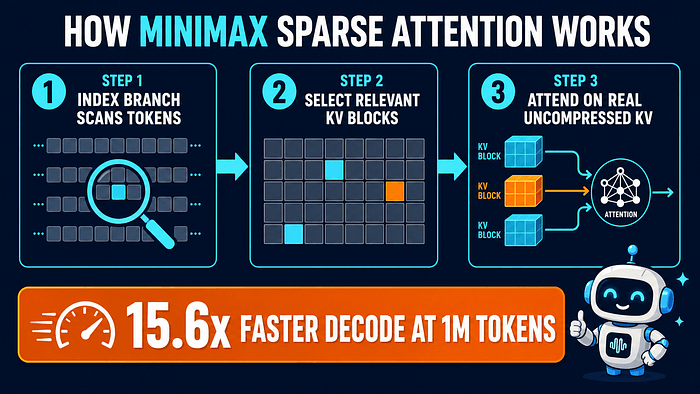
MiniMax M3 is shaking up the AI landscape by decoding 1M tokens 15.6x faster at a fraction of the cost. But it's the architecture, not just the speed, that demands attention.
June 1 marked a quiet revolution in AI as a Shanghai lab unveiled the MiniMax M3, a model decoding a 1-million-token context 15.6 times faster than its predecessor, and doing so at just 8% of the cost you'd expect from competitors like Claude Opus.
Unpacking the MiniMax M3 Innovation
What truly sets MiniMax M3 apart isn't just its impressive speed or the headline-grabbing SWE-Bench results. It's the model's underlying architecture, the MiniMax Sparse Attention (MSA), that makes it a game changer. Unlike standard attention mechanisms, which get prohibitively expensive at high token counts, MSA brings something fresh to the table.
MSA utilizes a lightweight index branch atop grouped-query attention to selectively process relevant KV cache blocks. This approach optimizes GPU memory access with a "KV outer gather Q" pattern, bypassing the inefficiencies of traditional methods like DeepSeek's MLA and NSA. Slapping a model on a GPU rental isn't a convergence thesis, MSA proves architecture matters.
The Economic Edge in AI
Pricing stands out as the MiniMax M3's most disruptive feature. Its low cost per-million-token input and output makes long-context agentic workflows not just possible, but economically sensible. While M3 shines in coding tasks, it stumbles in multimodal grounding and hallucination-related performance. Yet, with agentic workflows, who needs a jack-of-all-trades?
reported benchmarks come with a pinch of salt. Vendor-reported scores without independent verification can be misleading. Moreover, with weights not yet released, independent testing remains a question mark. Show me the inference costs, then we'll talk about its true worth.
Testing and the Path Forward
For those eager to harness this new capability, MiniMax offers quick integration via OpenRouter or their API. Practical tests should focus on long-context behaviors to see where M3 truly excels. But the real question is whether the industry will follow suit or dismiss this as a one-off innovation.
, while the M3 might not top the class in intelligence, it opens a new category with its cost-effectiveness and 1M-token economic viability. The race is on to see if this model's architecture will redefine the market standards or simply serve as a fleeting novelty.
Get AI news in your inbox
Daily digest of what matters in AI.
Key Terms Explained
A mechanism that lets neural networks focus on the most relevant parts of their input when producing output.
Anthropic's family of AI assistants, including Claude Haiku, Sonnet, and Opus.
Graphics Processing Unit.
Connecting an AI model's outputs to verified, factual information sources.