Mastering SVMs: The Kernel Trick That Transforms AI Models
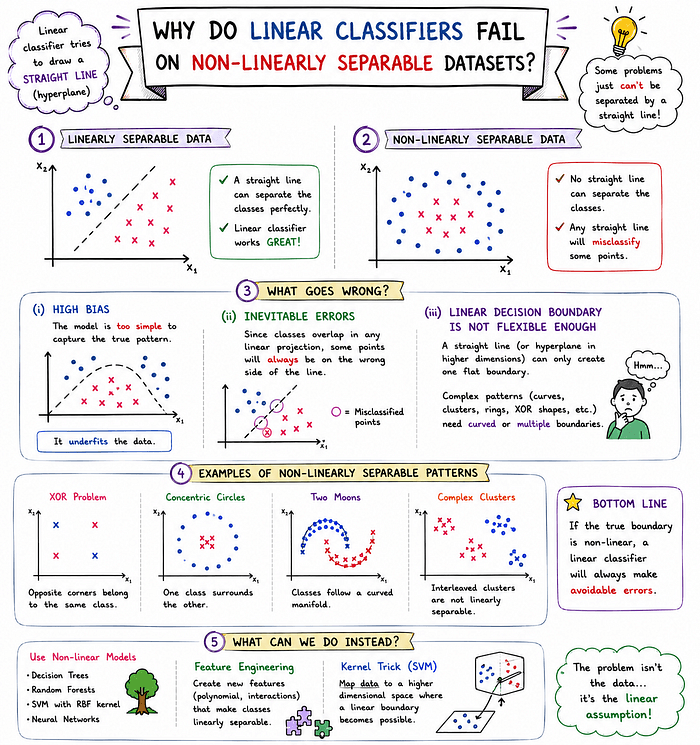
Support Vector Machines (SVMs) are essential for tackling non-linear classification challenges. The key? Understanding when and why kernels work their magic.
Let's face it, linear classifiers stumble when confronted with non-linearly separable datasets. Enter Support Vector Machines (SVMs). They're not just another tool in the AI toolbox. they're a scalpel for dissecting complex data patterns.
Why Linear Classifiers Fall Short
Linear classifiers are like trying to fit a square peg in a round hole non-linear data. They simply can't draw the necessary curves to separate complex datasets. So what's the solution? A dash of creativity and some mathematical magic, specifically, feature transformation techniques.
The Kernel Trick: SVMs' Secret Sauce
Feature transformation might sound like a mouthful, but it's really just a way to project data into higher dimensions where it can be linearly separated. The kernel trick is the secret sauce that allows SVMs to do this efficiently. Imagine transforming a dataset so it suddenly makes perfect sense. That's the power of the kernel.
But why stop there? Kernel functions are considered powerful because they enable SVMs to operate in these higher dimensions without explicitly mapping data points. It's a neat trick that saves time and computational resources.
Kernel Options: Choosing Your Weapon
SVMs come with an arsenal of kernels: linear, polynomial, and RBF (Radial Basis Function). Each has its pros and cons. Linear kernels are fast and simple. Polynomial kernels add complexity, but also flexibility. RBF kernels? They're the all-rounders, often the default choice when you're unsure.
However, don't let the shiny features distract you. Kernel methods bring their own challenges. They can be computationally intensive and sometimes lead to overfitting if not handled with care.
More Than Meets the Eye
Is SVM inherently linear or non-linear? It's both. The algorithm itself is linear, but with kernels, it can tackle non-linear problems. Versatility is its middle name. And if you're thinking SVMs are just for binary classification, think again. They can handle multi-class problems too, using approaches like one-vs-all or one-vs-one.
Don't pigeonhole kernels as exclusive to SVMs. They're useful in other algorithms too. Ever heard of Gaussian Processes or Principal Component Analysis? Yep, they use kernels as well.
When does SVM outshine Logistic Regression? When your data has a complex boundary and a high number of dimensions. Logistic Regression may be easier to interpret, but SVMs often deliver better performance.
So, what's the takeaway? SVMs aren't just for the mathematically inclined. They're for anyone tackling complex classification tasks. Its flexibility and power are unmatched, especially when you tap into the right kernels.
Get AI news in your inbox
Daily digest of what matters in AI.