Is Fine-Tuning Really Out? The Rise of Context Orchestration
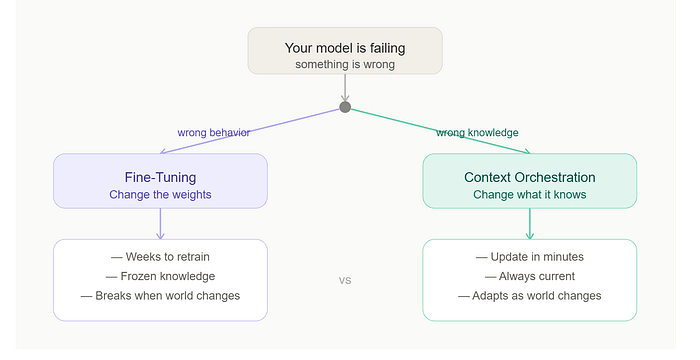
Fine-tuning in AI isn't dead, but context orchestration offers a more adaptable solution for most tasks. Understanding this shift could save you time and resources.
Every few months, something in the AI world gets declared obsolete. The latest victim? Fine-tuning. Yet, if you've ever trained a model, you know it's not so cut-and-dried. Fine-tuning isn't dead, but for most teams, it's not the first go-to anymore. The real shift? Context orchestration has stepped in as the more adaptable player.
Why the Change?
Fine-tuning has been overused, often wielded like a hammer for every AI nail. The analogy I keep coming back to is trying to use a sledgehammer to fix a watch. Sure, fine-tuning can fundamentally change a model's behavior, but is that what you really need? Most times, it isn't. It’s more about keeping up with dynamic data, facts that change daily.
Here's the thing, when you embed facts into model weights, you're freezing something that should be fluid. Imagine updating your model every time a product spec changes. It's not only costly in time but also in compute budget.
Understanding Context Orchestration
Think of it this way: context orchestration is like being a conductor of an orchestra. It’s not just about writing a better prompt or cramming more data into a long context window. It involves layering and dynamically integrating information into your model’s responses.
Context orchestration allows your model to adapt to new information without needing extensive retraining. This means fewer frozen models and more flexibility to evolve with your data. Why should this matter to you? Because it lets you avoid the pitfall of locking in yesterday's decisions on information that's changed today.
Fine-Tuning's Last Stand?
So, is there still room for fine-tuning? Absolutely, but it's a niche. Stable behavior that doesn’t change, like brand tone or output structure, can still benefit from fine-tuning. But honestly, how often does that happen? If your model’s primary failure is factual accuracy, it’s probably a case for context orchestration.
Let's be frank, most teams misunderstand this. They treat every wrong output as a behavior issue when it's often a facts problem. Fine-tuning becomes an expensive Band-Aid for a wound that needs a different kind of treatment.
In the end, the choice between fine-tuning and context orchestration isn't about what's dead or alive. It's about asking the right question: Do we need to teach this model new behavior, or does it just need better information?
Get AI news in your inbox
Daily digest of what matters in AI.
Key Terms Explained
The processing power needed to train and run AI models.
The maximum amount of text a language model can process at once, measured in tokens.
The process of taking a pre-trained model and continuing to train it on a smaller, specific dataset to adapt it for a particular task or domain.