Inference Engines: Picking the Right Runtime in 2026
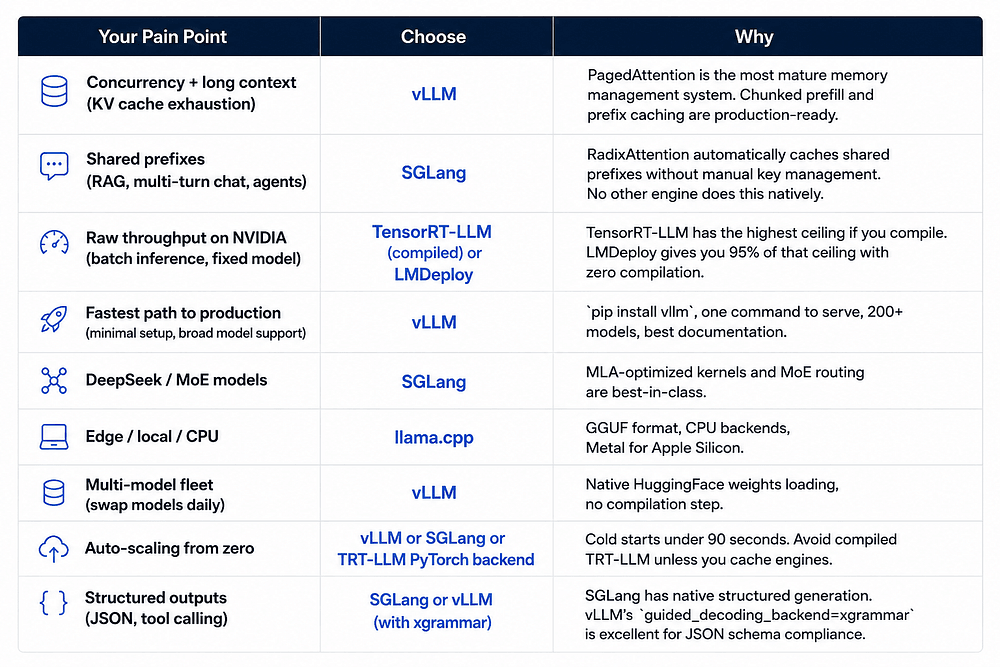
Choosing the right inference engine is critical for scaling AI models efficiently. In 2026, options like vLLM and SGLang each offer unique benefits and tradeoffs for different workloads.
Inference engines aren't just neutral tools. They come loaded with assumptions about how you're going to batch, cache, and decode your AI models. Picking the right one is key, especially when a model's efficiency means the difference between easy scaling and hours of wasted work.
vLLM: The Safe Bet for Many
For most teams, vLLM remains the go-to. Its standout feature, PagedAttention, turns the KV cache into a virtual memory system. This innovation slashes fragmentation, boosting concurrency on GPUs by two to four times. With this engine, you get continuous batching and automatic prefix caching, all without reinventing the wheel.
Yet, the vLLM isn't without its limitations. Its peak throughput on dedicated H100 clusters lags by about 29% compared to others like SGLang or LMDeploy. But if you're working across various models and GPUs, vLLM's broad support and community make it unbeatable.
SGLang: The Challenger
SGLang is no longer just an alternative. It's a powerhouse for xAI's Grok 3 and Microsoft's DeepSeek R1. Its secret? RadixAttention, which automatically reuses KV cache across shared token sequences. This is a major shift for workloads dominated by multi-turn interactions.
In benchmarks on H100 hardware, SGLang delivers around 29% more throughput than vLLM with unique prompts. However, vLLM's mature PagedAttention gives it an edge under high-memory pressure. The real question: Do you need that extra throughput, or is the automatic prefix handling of SGLang more valuable to you?
TensorRT-LLM: The NVIDIA Optimizer
For those working with NVIDIA hardware, TensorRT-LLM offers unmatched raw throughput. But there's a catch. Traditionally, you needed to compile a model into a serialized engine, a process taking nearly half an hour. That's a non-starter for auto-scaling.
Enter the PyTorch backend, slashing cold start times to under 90 seconds. Sure, you'll sacrifice some peak throughput, but unless your operation is squeezing every ounce of performance, that's a tradeoff many are more than willing to make.
Slapping a model on a GPU rental isn't a convergence thesis. The intersection is real. Ninety percent of the projects aren't. So, when choosing an inference engine in 2026, align it with your specific needs. Show me the inference costs. Then we'll talk.
Get AI news in your inbox
Daily digest of what matters in AI.