How Stack Overflow Became AI's Unlikely Mentor
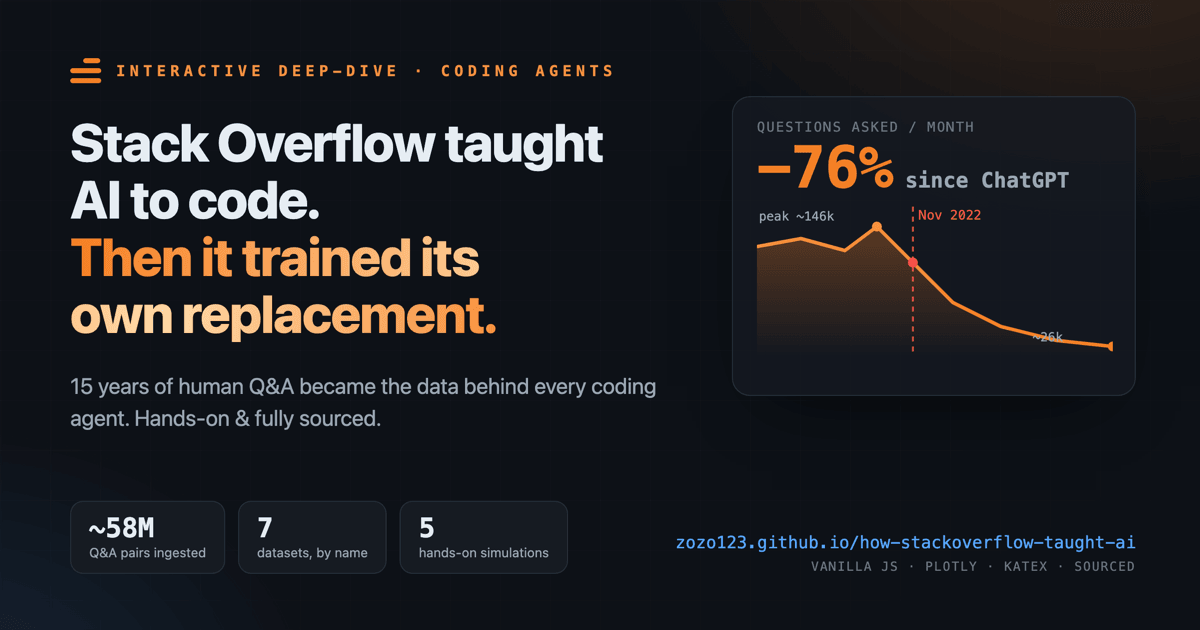
Stack Overflow has become an unexpected cornerstone for AI training, shaping how models interpret human queries. As AI systems evolve, the role of developer-written content is both key and problematic.
Stack Overflow, the beloved Q&A platform for developers, has unknowingly turned into an AI training ground. What began as a digital hub for human programmers to solve coding dilemmas is now key to AI's ability to process and generate human-like responses. This transformation raises questions about the future of both AI training and open-source knowledge.
The Accidental Mentor
It's no surprise that AI models, hungry for data, sought the vast repositories of Stack Overflow. Since its inception in 2008, the platform accumulated millions of coding questions and answers. This content, crafted by developers for developers, provides AI with a rich source of human language patterns, technical terminology, and problem-solving methodologies.
One could argue this is an efficient use of resources. However, slapping a model on a GPU rental isn't a convergence thesis. AI trained on user-generated content inherits not only the expertise but also the biases inherent in those responses. So, if the AI can hold a wallet, who writes the risk model?
The Echo Chamber Dilemma
Reliance on Stack Overflow data presents a significant risk: the creation of an echo chamber. AI models learn from both best practices and the mistakes logged on the platform. If unchecked, these systems could perpetuate inaccuracies, reflecting the flawed or outdated practices of the humans who initially typed those words.
Let's not forget the community aspect. Developers contribute to Stack Overflow for the love of sharing knowledge, not to have their insights mined by AI conglomerates. This raises an ethical question: Who really owns the answers?
AI's Future: Beyond Copycat Learning
The use of Stack Overflow data is a double-edged sword. On one hand, it's a treasure trove of real-world coding dilemmas and solutions. On the other, it's also a snapshot of developer biases and misinformation. The intersection is real. Ninety percent of the projects aren't. But that remaining ten percent could redefine how artificial intelligence systems engage with human content.
For developers and AI researchers alike, the next step is clear: move beyond training models to mimic existing human solutions and instead focus on fostering genuine computational creativity. It's not just about harvesting data but understanding context, nuance, and the potential for innovation. Show me the inference costs. Then we'll talk.
Get AI news in your inbox
Daily digest of what matters in AI.
Key Terms Explained
The science of creating machines that can perform tasks requiring human-like intelligence — reasoning, learning, perception, language understanding, and decision-making.
Graphics Processing Unit.
Running a trained model to make predictions on new data.
The process of teaching an AI model by exposing it to data and adjusting its parameters to minimize errors.