How AI Is Taking Away Your Ability to Do Your Own Work
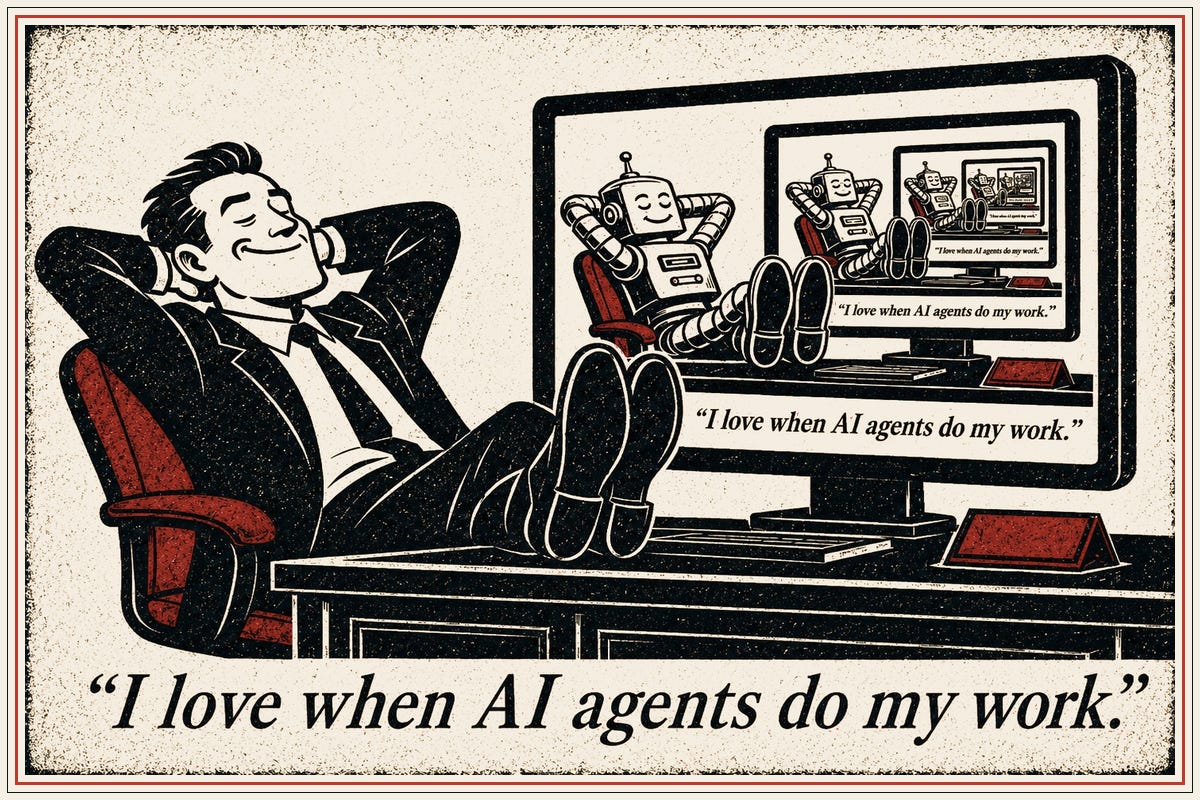
And seven things you can do to stop it

Hey there, I’m Alberto! 👋 Each week, I publish long-form AI analysis covering culture, philosophy, and business for The Algorithmic Bridge. Paid subscribers also get Monday how-to guides and Friday news commentary. I publish occasional extra articles. If you’d like to become a paid subscriber, here’s a button for that:
A practical guide on how to deal with agentic AI vices that degrade your work.

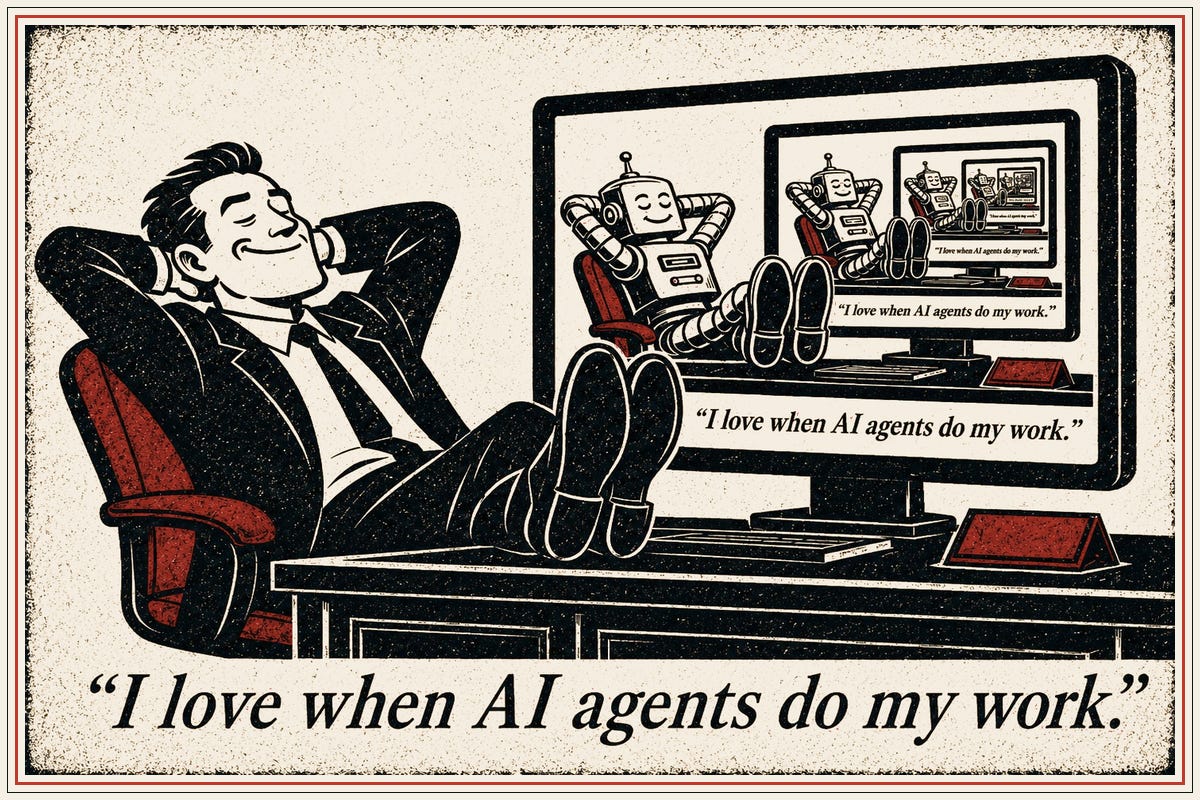
If AI has taught me anything, it is that struggling because you have to do work is better than struggling because you don’t.
We yearn to free ourselves from work right until the moment we do. Then we yearn to bring it back. AI has put an end to that paradox: it removed the struggle to do work and won’t give it back unless you make the effort to backtrack from the habits you’re currently building. Your work doesn’t require you, and you don’t know how to deal with that.
And so tweets like this one below appear on my feed every day.
The sentiment has generalized across software development jobs and more broadly, white-collar jobs. Work has become, like everything else, a casino slop machine. You pull the lever, you get something, you evaluate the situation. You pull the lever again. Etc. You don’t do stuff anymore. You manage and oversee and organize and hover over tasks, not fully detached but not engaged either.
The sheer amount of work that an AI agent—or a swarm of them—can do prevents you from getting in the mud with it. You are not fast enough, can’t go deep enough. And so you hover over. Your work consists of chaining together a ridiculous number of decisions one after another—including the decision to delegate decisions—without feeling the friction of making them. The number of choices you make is daunting, but volume is not your problem.
The problem is that being an evaluator for a living doesn’t feel like being a generator, which is what your brain wants to be. When you generate the work, you have to ask “what should I build?” or “How do these elements connect?” When you evaluate the work, you go, “Is this what I want?” “Does this meet the requirements?”
You’re constantly in a cognitive mode that’s purely consuming a mental model proposed by the AI; you don’t get to build it yourself. How can you consume a resource you don’t replenish?
That question is at the core of the “brain fog” or the “brain fry” testimonials. The more you take on this manager role, the less time you spend honing the practice of “understanding by doing” and so the worse you actually become at managing itself because your mental models increasingly drift away from the actual nature of the tasks you have to manage.
Mastering AI agents is a matter of finding the sweet spot. Just doing keeps you good at doing. Doing plus managing makes you good at both. Just managing makes you good at none.
Something similar has happened to me.
I use AI to help me research, and it’s good at gathering plenty of material from reputable sources in a matter of minutes. That’s great—it was literally impossible without AI. But then I’d realize that I don’t know what to do with it: I have 500 pages of good-quality information, and it means nothing to me because I’m disconnected from the process that brought it to me. I’m lost in the middle of an ocean. Turns out that the output of research is not the goal of research. If I did scour the internet looking for sources, I would make connections that I need. Ideas present themselves before me during the act of actively looking for stuff, not passively receiving stuff. I lose that by offloading the process. The output of research is only worth for me contingent on my putting it together.
These ideas have never been more relevant. They are not exclusive to AI—as it always happens with innovation, we readily jump into it but rarely zoom out of it to take perspective—and far from new.
In her 1983 landmark paper Ironies of Automation, Lisanne Bainbridge observed that the more you automate a process, the more you need, as the human operator, to be skilled (for edge cases, for oversight, etc.), but the less practice you get. Google and Stack Overflow entail partial offloading, yes, but you still need to generate the work yourself. Generative AI takes that away from you.
With AI, the product of your work comes out faster, but your participation thins and thins. Perhaps, if you’re lucky, the product is better, but you, in contrast, are worse. When you start to think in terms of “what” and forget to do the “how,” you eventually don’t know “what” the hell is going on.
The fix is not hard, just requires an intentional mindset change.
What you need to do to keep the benefits of agentic AI—returning entirely to pen and paper isn’t realistic—whilst not surrendering your skills as a human, is to switch between evaluative cognition and generative cognition. Keep doing the thing, start managing the thing, and get better at both.
I think the idea of “desirable difficulty” is the sweet spot you should aim for. It’s not maximizing evaluative skills. It’s not maximizing hands-on skills either. It’s a weighted mix of both that depends on who you are, your skills, your job, etc. Only you can find the right combination.
My general advice is this: don’t be afraid to backtrack from fully relying on agents just because your peers and the industry are telling you to go full “AI manager mode.”
Eventually, they, too, will have to do this, which gives you an important edge if you start now. Eventually, they will realize that it was a mistake. One born out of a desire to work less and work faster. The correct desire, however, should be to work better, which is rarely achieved by either. In the AI era, better work requires you to gain those AI skills without losing your human ones.
Now that I’ve stated the situation, you’re in a position to understand my practical advice below. Seven things you should stop doing right now to become the best “human doer” + “AI manager”:
Stop automating the tasks that teach you things
Stop rejecting AI output on fuzzy judgment
Stop offloading to agents right away
Stop splitting your work into “AI” and “human” tasks
Stop choosing two birds in the bush
Stop using AI to evaluate AI to evaluate AI
Stop deferring the understanding to later

IMPORTANT REMINDER
I’m running a 50% discount offer on annual subs that ends on June 5th. Get yours now and enjoy the discount forever.
If you read the free edition and have been thinking about subscribing, this is the best time. I won’t do another offer anytime soon.

Get AI news in your inbox
Daily digest of what matters in AI.