GRASP: Redefining Long-Horizon Planning with World Models
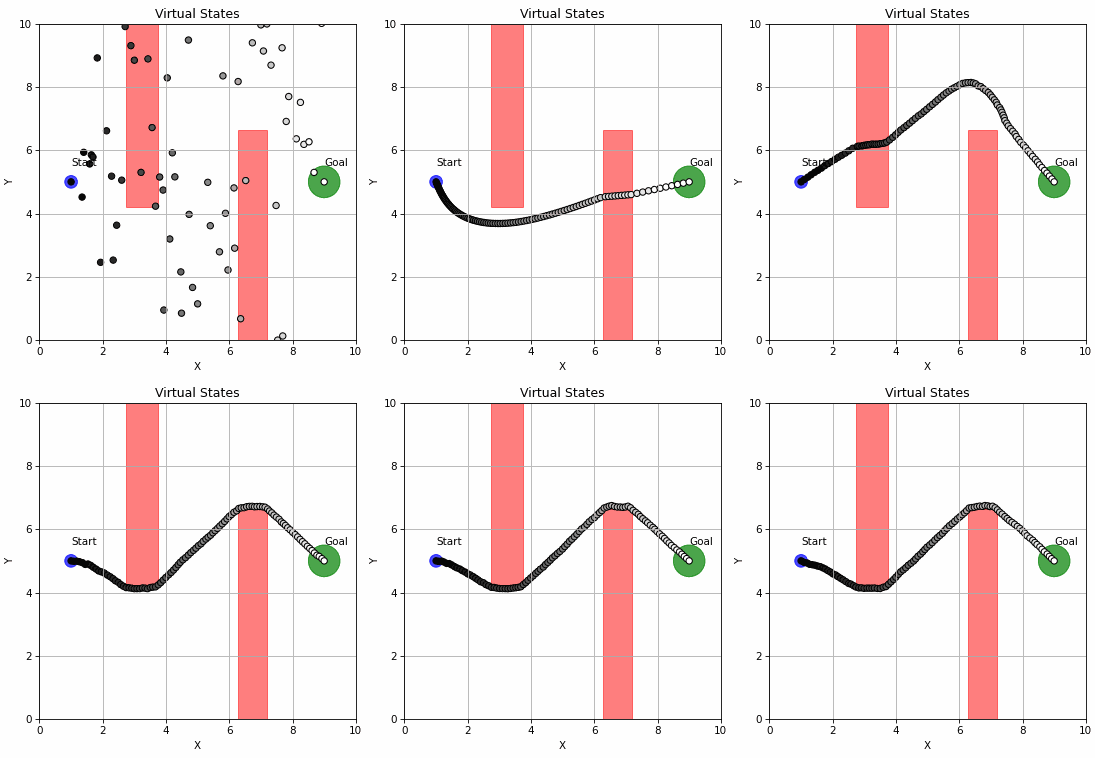
GRASP, a novel gradient-based planner, tackles the challenges of long-horizon planning in AI by introducing virtual states and reshaping gradients. The system sidesteps the pitfalls of state-input gradients, enabling more reliable and faster planning.
landscape of artificial intelligence, one challenge persists, long-horizon planning. Enter GRASP, a revolutionary planner developed by a team including Yann LeCun and Michael Psenka, promising to make long-horizon planning not just practical but efficient.
The Shortcomings of Current Models
World models have grown exponentially in capability, predicting complex sequences and generalizing tasks in unprecedented ways. Yet, their application in planning remains fragile. High-dimensional latent spaces and ill-conditioned optimization often lead to failure, especially with extended horizons.
Why? The answer lies in the inherent issues of exploding and vanishing gradients, compounded by the non-greedy nature of longer tasks that often require creative problem-solving beyond straightforward solutions.
A New Approach with GRASP
GRASP offers a fresh perspective by lifting the dynamics constraint into virtual states, introducing stochastic state iterates for exploration, and reshaping gradients to avoid the brittleness of state-input gradients. This approach allows actions to receive clear signals, bypassing the pitfalls of high-dimensional vision models.
Imagine navigating through a maze. Traditional methods might charge headlong into walls, but GRASP suggests a more strategic path, recognizing when to backtrack or seek alternative routes.
Tackling Adversarial Robustness
A significant hurdle for deep learning models is adversarial robustness. Subtle perturbations can easily mislead models, a vulnerability GRASP addresses head-on. By focusing on the more stable action gradients and minimizing reliance on state-input gradients, GRASP provides a solution that remains grounded and reliable.
But let's ask the tough question: Is this enough? While GRASP shows promising results, success rates and efficiency are only part of the equation. We must also consider the ethical implications and who benefits from these advancements.
GRASP's performance in tests is notable, significantly increasing success rates and reducing the time to achieve goals. For instance, with a horizon of 80, GRASP achieved a 10.4% success rate in just 58.9 seconds, outperforming other methods by a wide margin.
Looking Ahead
There's still a long road ahead for world model planners. While GRASP is a promising start, integrating it into solid, real-world applications remains a challenge. Future directions could involve adapting GRASP for closed-loop systems or reinforcement learning, expanding its utility and efficacy.
As we continue to push the boundaries of AI, the question looms: How do we ensure these innovations serve all communities equitably? The affected communities weren't consulted.
Ultimately, GRASP's development represents a key step forward, but accountability requires transparency. Here's what they won't release. The real test will be in its deployment and the tangible impact it has beyond the confines of a research lab.
Get AI news in your inbox
Daily digest of what matters in AI.
Key Terms Explained
The science of creating machines that can perform tasks requiring human-like intelligence — reasoning, learning, perception, language understanding, and decision-making.
A subset of machine learning that uses neural networks with many layers (hence 'deep') to learn complex patterns from large amounts of data.
The process of finding the best set of model parameters by minimizing a loss function.
A learning approach where an agent learns by interacting with an environment and receiving rewards or penalties.