GENISOM AI's Leap: From Lab to Real-World Robots at ICRA 2026
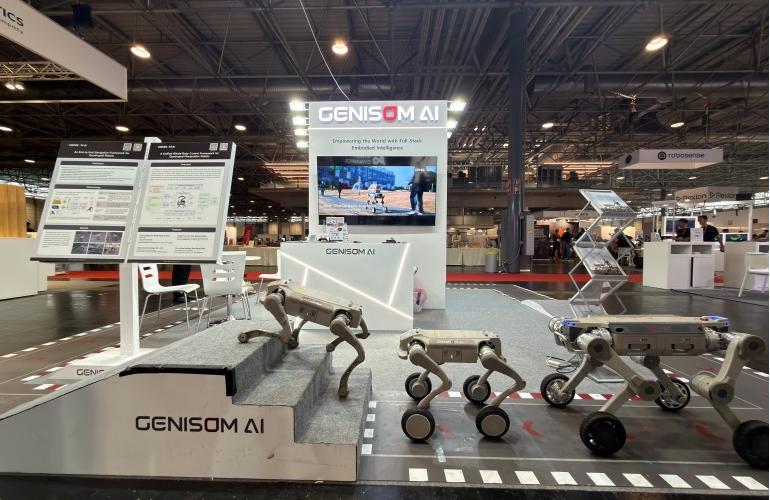
GENISOM AI, a Beijing-based robotics firm, has shifted from concept to production, debuting its solid M1 and L1 robots at ICRA 2026. With over 10,000 units shipped, it's redefining scalability in the robotics industry.
At ICRA 2026, robotics insiders got a closer look at GENISOM AI. Although new to some, this Beijing-based company isn't a fledgling startup. Since December 2023, they've shipped over 10,000 units. That's production scale in less than three years, a feat few in robotics achieve.
From Concept to Mass Production
GENISOM AI isn't just another company with lab prototypes. It's delivering mass-produced robots ready for real-world deployment. At the conference in Vienna, they showcased the M1 and L1-series. These aren't just fancy demos. They're industrial-grade machines.
The M1, for instance, boasts a 30 kg walking payload with a near 1:1 payload-to-weight ratio. It carries an IP67 rating, running for five hours under the right conditions. Its in-house P85MAX-S joint actuator module gives it up to 180 N·m of torque. Why does this matter? Because it means GENISOM AI controls the hardware-software integration, a critical factor in performance and reliability.
Beyond the Conference Floor
The M1 Ultra isn't just about moving. It sees. Using bird's eye view-based fusion techniques and 720° spatial awareness, it's like having a drone's vision on the ground. This isn't just a tech showcase. It's a practical tool in applications from security to emergency response.
GENISOM AI's educational platform, the L1 EDU, also turned heads. With NVIDIA Jetson Orin NX and Livox Mid-360 lidar, it's built for research and open-source development. The University of Manchester proved its worth by winning first place at the IROS 2025 Quadruped Robot Challenge using this platform. That's validation you can't ignore.
A Platform, Not Just Products
GENISOM AI's reach isn't limited to selling robots. Their focus is on the entire robotics stack. They offer core components, software toolchains, and even simulation platforms like MATRiX, which marries MuJoCo physics and Unreal Engine for realistic training environments. Plus, the company's Real2Sim2Real Data Flywheel transforms consumer-grade captures into simulation assets, slashing development costs.
Their partners aren't just buyers. They're collaborators. Whether it's ODM customization or field application support, GENISOM AI offers a comprehensive package. And for developers? The SDK and GitHub resources are open for exploration. Clone the repo. Run the test. Then form an opinion.
So, what's GENISOM AI's real achievement here? It's not just about making robots. It's about building a scalable, deployable platform. Are they redefining what it means to be a robotics company in 2026? Absolutely.
Get AI news in your inbox
Daily digest of what matters in AI.