Fusing AI with Military Strategy: A New Era of Decision Making on the Battlefield
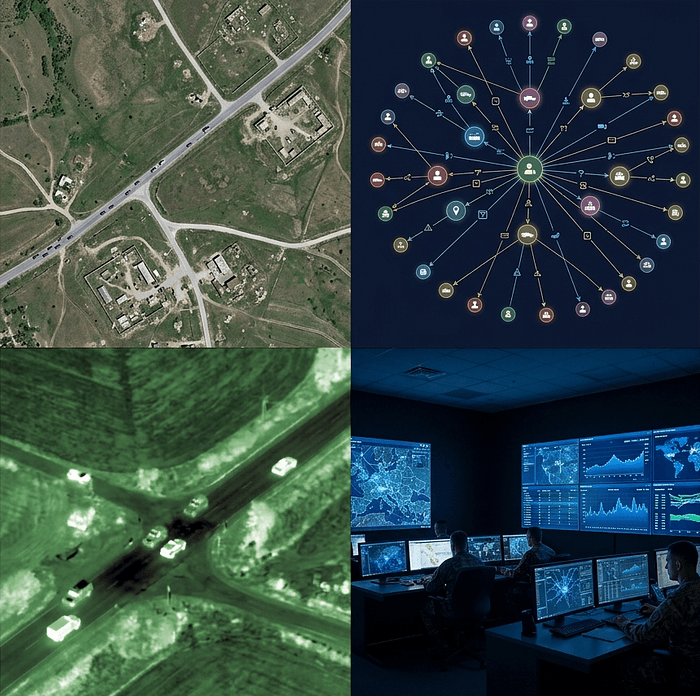
In the space of military intelligence, AI is reshaping decision-making processes. Integrating LLMs and GNNs with knowledge graphs offers a real-time, dynamic approach to challenges on the battlefield.
Modern military intelligence isn't just about gathering data. It's about synthesizing it into actionable insights in real-time. Imagine a scenario where a vast sensor network detects unusual activity across a 200-kilometer front, and various data sources converge to create a chaotic information landscape. The clock is ticking, with only ninety seconds to make a critical decision that could impact lives and military outcomes.
The Limitations of Traditional Tools
In such high-stakes environments, traditional AI models falter. Supervised classifiers crumble when adversaries intentionally disrupt data patterns. Meanwhile, vanilla LLMs are prone to hallucinations, especially under sparse data conditions. They struggle to track evolving scenarios without forgetting essential information.
Even worse, traditional databases fall short. They can't handle the contradictory and probabilistic nature of battlefield data in real-time. The defense sector saw this gap and acted. The KAIROS program, running from 2019 to 2023, laid the groundwork for systems that could interpret noisy multimedia inputs. By 2025, programs like GenAI.mil were pushing for AI-centric decision-making workflows across military operations.
The Fusion Stack: A New Architecture
Here's where it gets practical. The solution isn't a single algorithm but an integrated approach. LLMs offer language-grounded reasoning, while Graph Neural Networks (GNNs) excel at relational inference. Knowledge graphs provide the underpinning semantic structure to ground these systems in reality. This fusion stack enables a comprehensive view of the battlefield, dynamically adjusting as new intelligence is received.
In warfare, information is relational. An intercepted signal gains meaning only when linked to its context, such as command hierarchies or geographic logistics routes. Knowledge graphs model these complex relationships, offering a dynamic view that evolves over time. Platforms like Palantir Gotham operationalize this kind of modeling, proving their worth in enterprise-scale applications.
Graph Neural Networks: Beyond Simple Queries
Standard graph databases are limited to exact matches, but GNNs transform the game. They enable probabilistic reasoning, predicting missing links and classifying entities from relational data. For instance, a GNN might identify an unknown actor as part of an air defense system by analyzing its network of connections, even if direct evidence is lacking.
Yet, GNNs alone aren't enough. They need to account for varying reliability of data sources, from secure military comms to civilian networks. Heterogeneous Graph Attention Networks (HAN) tackle this by weighing the reliability of different data paths, much like a seasoned analyst would prioritize information sources.
LLMs: Bridging the Gap
Finally, LLMs come into play to interpret the high-dimensional outputs of GNNs into actionable insights. They bridge the gap between complex data and human decision-making. But let's be clear: LLMs can't work alone in these scenarios. The real-world complexity of military operations demands this integrated approach.
The deployment story is messier, but the payoff is significant. The fusion of these technologies doesn't just enhance decision-making speed and accuracy. It fundamentally changes how military operations can be conducted, offering a new layer of strategic depth and flexibility.
The real test is always the edge cases, those unpredictable scenarios where traditional systems would falter. In the end, the integration of AI in military strategy isn't just a technological evolution. It's a strategic revolution.
Get AI news in your inbox
Daily digest of what matters in AI.
Key Terms Explained
A mechanism that lets neural networks focus on the most relevant parts of their input when producing output.
Running a trained model to make predictions on new data.
The ability of AI models to draw conclusions, solve problems logically, and work through multi-step challenges.