Festo's HPPH Gripper and GripperAI: A New Era in Robotics?
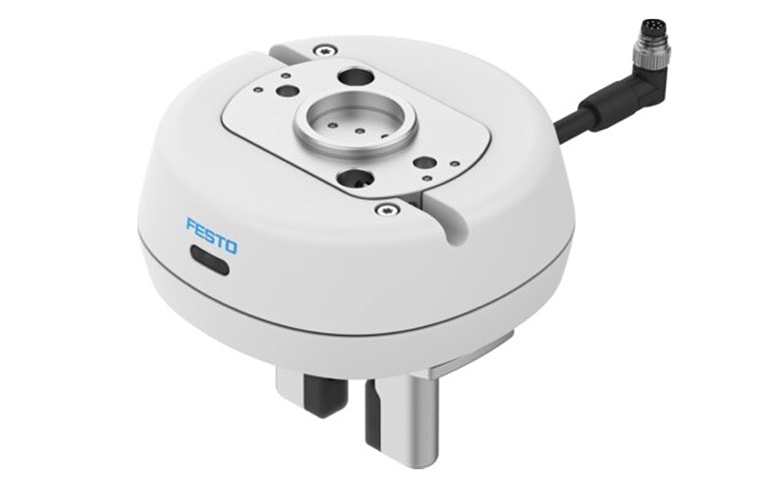
Festo's new HPPH gripper integrates control systems directly into the device, reducing complexity for collaborative robots. Meanwhile, their GripperAI software aims to simplify material handling with AI-driven flexibility.
Festo has unveiled a new player in the robotic gripper market: the HPPH two-finger pneumatic parallel gripper. This lightweight device integrates controls, sensors, and safety features directly into its body, sidestepping the cumbersome payload and wiring constraints that typically plague collaborative robots. This isn't just incremental improvement. it's a breakthrough for optimizing payload capacity and simplifying the clutter of mounting and wiring on robot platforms.
Revolutionizing Collaborative Robots
In a world where force- and power-limited robotic arms are bound by stringent payload constraints, the HPPH gripper comes as a breath of fresh air. By stripping away unnecessary external components, Festo effectively preserves the payload capacity of these collaborative robots. It's a clever design choice, integrating the pneumatic control valve and position sensors into the gripper itself, making installation a breeze and reducing commissioning time significantly.
But does it live up to the hype? The HPPH weighs a mere 1.5 pounds, yet supports handling objects weighing up to 2.2 pounds. Its maximum gripper opening of 0.63 inches might seem modest, but this integration promises to keep the robot's workload light and efficient. If the AI can hold a wallet, who writes the risk model?
GripperAI: Intelligence at the Edge
Simultaneously, Festo's GripperAI doesn't just dabble in AI, it leaps ahead. Designed to operate in chaotic environments without pre-programming, this software is compatible with a variety of grippers. Its AI-driven approach identifies optimal grasping points, making material handling more flexible and accessible across industries.
GripperAI aims to resolve one of the most persistent challenges: handling unfamiliar objects without manual intervention. It promises setup time savings and operational efficiency, allowing robots to grip previously unseen objects, saving time and resources. Decentralized compute sounds great until you benchmark the latency, but this is a step toward addressing that with minimal hardware requirements.
What Does This Mean for Robotics?
Festo's innovations push the boundaries, but they also raise key questions. How will these advancements impact the future design of collaborative robots? The industry's trajectory seems to be moving toward more integrated, intelligent systems that reduce the complexity of robotic operations. Yet, the true test will be in real-world applications.
Würth Group's tests of GripperAI in logistics showcase this potential. Their robots, equipped with GripperAI, tackled mixed, randomly oriented items. Imagine the operational efficiencies across manufacturing, logistics, and packaging. The intersection is real. Ninety percent of the projects aren't. But this one just might be.
Get AI news in your inbox
Daily digest of what matters in AI.