Enterprise AI Needs More Than Just Prompts
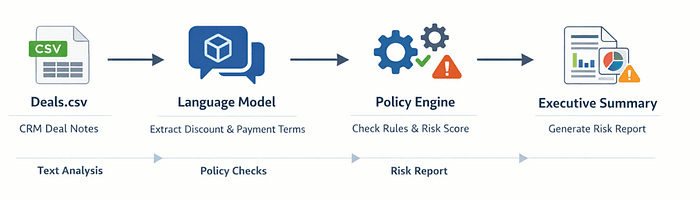
Enterprise AI adoption often starts with simple language models, but operational teams require more solid solutions. A hybrid approach using LangChain can bridge the gap.
Enterprises dipping their toes into the AI pool often start with language models. It’s a logical first step, using AI to summarize documents or classify customer service tickets seems like a no-brainer. But here’s the kicker: these systems, while efficient in handling text, fall short executing policy-driven decisions. Revenue Ops and Deal Desk teams need more than just AI-generated text. They need reliable, auditable decisions.
Why Text Isn't Enough
Take a routine CRM note, for instance. A salesperson notes that a customer is mulling over a multi-year rollout and procurement is pushing for a 42% discount due to competition. Meanwhile, finance is asking for 90-day payment terms to align with their budget cycle. A human reviewer sees this and instinctively knows: escalate the deal, the discount’s too steep, and the payment terms are too long. This isn't some AI magic, it's business policy applied to complex language.
What’s the solution? Stop seeing language models as standalone decision-makers. Instead, the real action is in a hybrid approach. AI can interpret those convoluted CRM notes while deterministic code enforces the business rules. That’s where a tool like LangChain comes into play.
LangChain: The Backbone of Effective AI
LangChain isn't just a tool. it’s a framework that lets language models interact with external systems reliably. It’s the secret sauce for turning an LLM into a cohesive part of a structured process. In the Deal Desk Intelligence Agent, LangChain delegates the language interpretation to AI, but ensures exact business rules through deterministic tools. Now, decisions aren’t just consistent, they’re also auditable.
Why should we care? Because a typical enterprise can’t afford to let AI hallucinate its way through policy enforcement. It needs those decisions to be rock-solid and repeatable. The strategic bet is clearer than the street thinks. By using LangChain, companies can build systems that are both smart and steadfast.
The Real-World Implementation
The architecture here's divided into three zones. First, the data input zone ingests raw CRM notes and sets up the operational parameters. Then, the agentic reasoning loop uses LangChain to coordinate between the LLM and Python tools, ensuring business rules are met without imagination getting in the way. Finally, in the structured decisions zone, the system generates an auditable dataset and a concise executive summary.
In short, the process transforms a simple CSV export into a reliable, decision-making tool. So next time someone suggests AI can’t handle business rigor, ask them this: If we can engineer AI to interpret language while strictly enforcing policy, what can’t we do?
Get AI news in your inbox
Daily digest of what matters in AI.