Demystifying Gradient Descent with Absolute-Value Loss
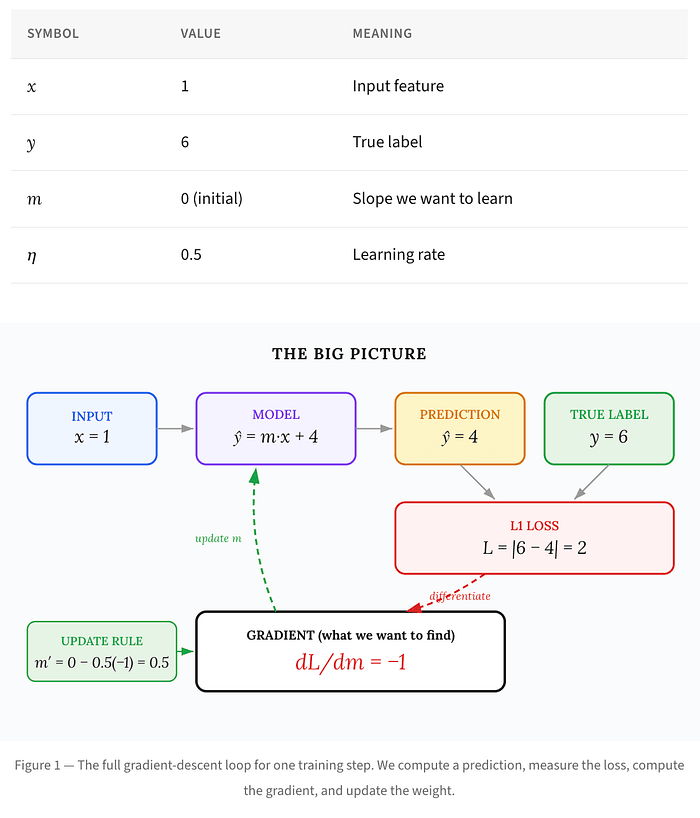
Understanding gradient descent with absolute-value loss is important for those navigating the complexities of machine learning. This exploration breaks down L1 loss gradients and their practical implications.
For anyone who's ever found themselves lost in the dense mathematical thickets of deep learning tutorials, there's a certain relief in stumbling upon an explanation that finally clicks. Gradient descent, a core concept of machine learning, becomes far more comprehensible when broken down step-by-step, especially when dealing with absolute-value loss, or L1 loss.
Understanding the Basics
The gradient of L1 loss with respect to a single weight might sound intimidating, but it serves as one of the most instructive calculations in machine learning. Why? Because it's simple yet profound in its implications. By examining a straightforward regression model, we can trace the loss function's path and derive the gradient through a methodical approach that marries clarity with practical application.
Concrete examples are key here. They not only aid comprehension but also help in progressively building the understanding necessary to apply the chain rule in calculus. This is essential for anyone serious about machine learning, as it forms the backbone of many optimization algorithms.
L1 vs. L2 Loss
So why should practitioners care about L1 loss in particular? The answer lies in its insensitivity to outliers. Unlike L2 loss, which responds dramatically to the magnitude of errors, L1 loss provides a stable alternative when outliers could skew results. This makes L1 a preferred choice in many real-world applications where robustness is desired over sensitivity.
But here's the real question: How often do we actually question the tools at our disposal? It's all too easy to follow popular trends without scrutinizing whether the chosen loss function genuinely aligns with our objectives.
The Takeaway
, choosing between L1 and L2 isn't just a technical decision but a strategic one. It requires an understanding of the data's nature and the desired outcomes from the model. Those who fail to apply the right loss function risk not just suboptimal performance but also a fundamental misinterpretation of their model's results.
In the rapidly evolving field of AI, the burden of proof sits with the team, not the community. As machine learning professionals, we owe it to ourselves to question, understand, and rigorously apply the standards the industry sets for itself.
Get AI news in your inbox
Daily digest of what matters in AI.
Key Terms Explained
A subset of machine learning that uses neural networks with many layers (hence 'deep') to learn complex patterns from large amounts of data.
The fundamental optimization algorithm used to train neural networks.
A mathematical function that measures how far the model's predictions are from the correct answers.
A branch of AI where systems learn patterns from data instead of following explicitly programmed rules.