Cursor vs. Claude: Unveiling Strategies in the AI Arena
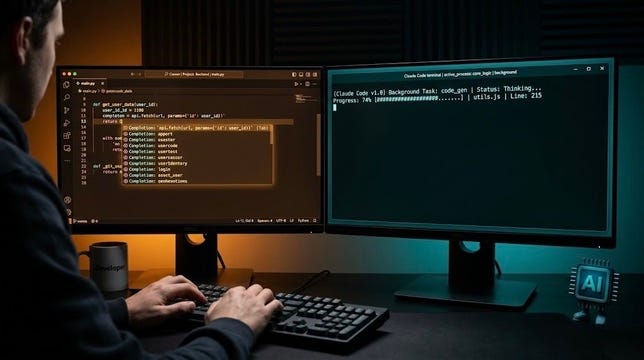
With Cursor's source code leak, the tech world glimpses a strategic battle. Cursor's interface-centric approach contrasts sharply with Claude's persistent AI vision.
On March 31, 2026, a massive leak hit the tech world as 512,000 lines of Claude Code’s source code were exposed online. Within hours, developers on Twitter were dissecting every unreleased feature, from KAIROS to Dream and beyond. But the real revelation wasn't about vulnerabilities, it was about strategy. Cursor’s strategy, to be precise, is more intriguing than it's been credited for.
Cursor's Strategic Bet
Cursor isn’t your typical AI firm like Anthropic. It's betting on the interface layer. Having raised $2.3 billion at a valuation of $29.3 billion in late 2025, it's clear the market sees potential. By mid-2025, it had achieved $500 million in annual recurring revenue, with its services adopted by over half of the Fortune 500. Its Composer 2 model, underpinned by Kimi K2.5 and custom reinforcement learning, has impressive scores on benchmarks. Yet, the true story is its reliance on Claude models. Claude Opus 4.6 and Gemini 3.1 Pro score over 80% on SWE-bench Verified, and Cursor routes through them. This isn’t a contradiction, it’s a calculated move. The model may be a commodity, but the interface is where Cursor stakes its claim.
Cursor argues that an AI's model is just raw material. It's the interface that creates value, an IDE that feels native to developers. That's what justifies its $29 billion market valuation. The leak didn't undermine this thesis. it validated it.
The Memory Architecture Revelation
One of the most fascinating insights from the source code was Claude's three-layer memory architecture. At its core is MEMORY.md, a lightweight index focused on location, not data. This setup means project knowledge is fetched on demand, not stored en masse. It's a system designed for persistence across sessions, unlike Cursor’s IDE-native architecture that operates within session boundaries. These differing philosophies don’t expose a capability gap, they highlight distinct product visions. While Cursor refined a smarter editor, Anthropic built a persistent colleague in Claude.
KAIROS: A New Challenge
The feature that should cause Cursor to pause isn't memory consolidation, it's KAIROS, Anthropic’s always-on background agent. It operates quietly, maintaining logs and deciding actions with minimal disruption. This agent doesn’t wait for instructions but acts autonomously, identifying and proposing fixes overnight. It shifts the developer-AI relationship away from user-directed to AI-guided.
What does this mean for Cursor? The leak doesn’t just unveil Anthropic’s plans, it challenges Cursor to rethink its own. Could Cursor replicate this? Certainly. But building an effective KAIROS requires more than just code. it needs an underlying model of high caliber. And that’s where the real competition lies, not in architecture but in model quality.
The street might think Cursor now has a roadmap to Anthropic’s future. But read between the lines: the real number here's about trust and model judgment, not just the orchestration. As Cursor continues to route through Claude models, the competitive landscape is clearer than many realize.
Get AI news in your inbox
Daily digest of what matters in AI.
Key Terms Explained
An AI safety company founded in 2021 by former OpenAI researchers, including Dario and Daniela Amodei.
Anthropic's family of AI assistants, including Claude Haiku, Sonnet, and Opus.
Google's flagship multimodal AI model family, developed by Google DeepMind.
A learning approach where an agent learns by interacting with an environment and receiving rewards or penalties.