Cracking GenAI Interviews: The Real Story Behind LLM and RAG Roles
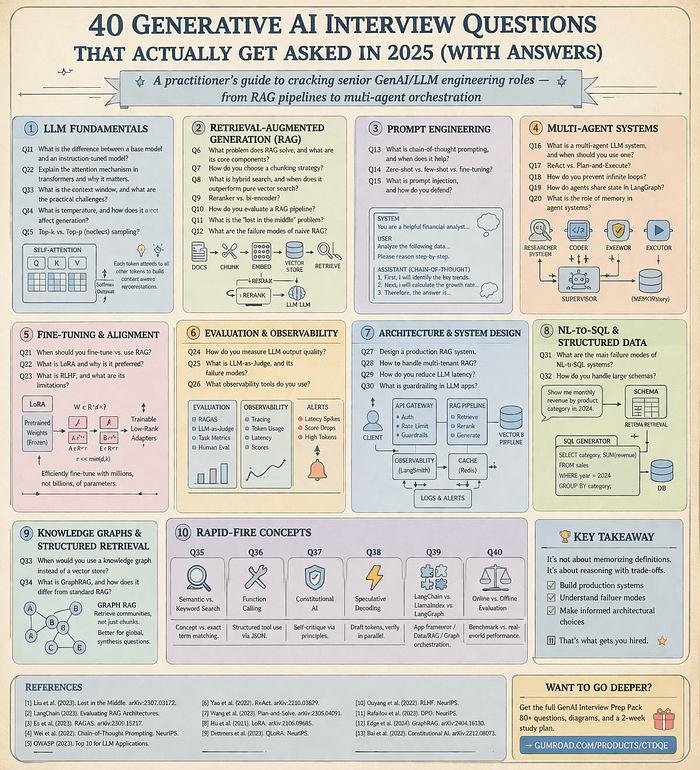
Generative AI interviews have evolved. It's not just about theory anymore. You need to show you're in the trenches, building real products. Here's what to expect.
Generative AI isn't just a buzzword anymore. It's the main event, especially if you're looking at senior roles in data science or machine learning. I've been on both sides of this table, so let me tell you, the questions have changed dramatically over the past couple of years.
From Theory to Practice
Gone are the days where you could skate by on theoretical knowledge. Interviewers want proof that you've been in the trenches, that you've built a Retrieval-Augmented Generation (RAG) pipeline that doesn't hallucinate, or a multi-agent orchestration that doesn't deadlock. Questions are getting real, and they're based on actual product scenarios.
Take the difference between a base model and an instruction-tuned model, for instance. Knowing that a base model just predicts the next token while an instruction-tuned model aligns with user intent is essential. It shows you understand the nuances of creating products that people will actually use. Fundraising isn't traction, remember?
The Nuts and Bolts of LLMs
Understanding the attention mechanism in transformers is essential for anyone serious about LLMs. It's what lets models track context over thousands of tokens, essential for any serious application. You also can't ignore issues like the 'lost in the middle' problem, where context gets ignored if it's not at the beginning or end.
Then there's the context window. Larger windows might seem better for in-context learning, but they come with a trade-off: quadratic attention complexity. Are you prepared to handle that in a real-world scenario?
RAG: Where the Rubber Meets the Road
RAG is designed to ground LLM outputs in reality, pulling from specific documents to avoid hallucinations. It's vital in a world where models have knowledge cutoffs. But building it isn't just about assembling components like document pipelines and vector stores. It's about optimizing them for the right retrieval accuracy.
And let's not forget hybrid search. It's not just a buzzword. it's practically a necessity in enterprise settings, where query distributions are often mixed. Relying solely on vector search when keyword precision is needed can be a rookie mistake.
But the real kicker? Evaluating a RAG pipeline. Do you focus on faithfulness and context precision? If not, you're missing the point. In production, these metrics are your best friends.
So, what's the takeaway? If you're eyeing a senior role in Generative AI, be prepared to show not just what you know, but what you've built. The founder story is interesting. The metrics are more interesting.
Get AI news in your inbox
Daily digest of what matters in AI.
Key Terms Explained
A mechanism that lets neural networks focus on the most relevant parts of their input when producing output.
The attention mechanism is a technique that lets neural networks focus on the most relevant parts of their input when producing output.
The maximum amount of text a language model can process at once, measured in tokens.
AI systems that create new content — text, images, audio, video, or code — rather than just analyzing or classifying existing data.