College Majors in the Age of AI: Changing Course for a Tech-Driven Future
With AI reshaping the job landscape, nearly half of college students consider changing their majors. As institutions lag in AI integration, students face new challenges and opportunities.
Almost half of college students today are seriously considering switching their majors, and it's all thanks to the looming shadow of AI on their future careers. In a recent survey, a whopping 47% of students reported they've mulled over this decision due to the potential impact AI might have on jobs.
The Job Market Shake-up
As graduates step into the workforce, they're entering a job market that's been thoroughly transformed by tech advancements. AI isn't just an abstract challenge. It's a real factor shaping which fields of study students are pursuing. Look closer, and the anxiety isn't evenly spread.
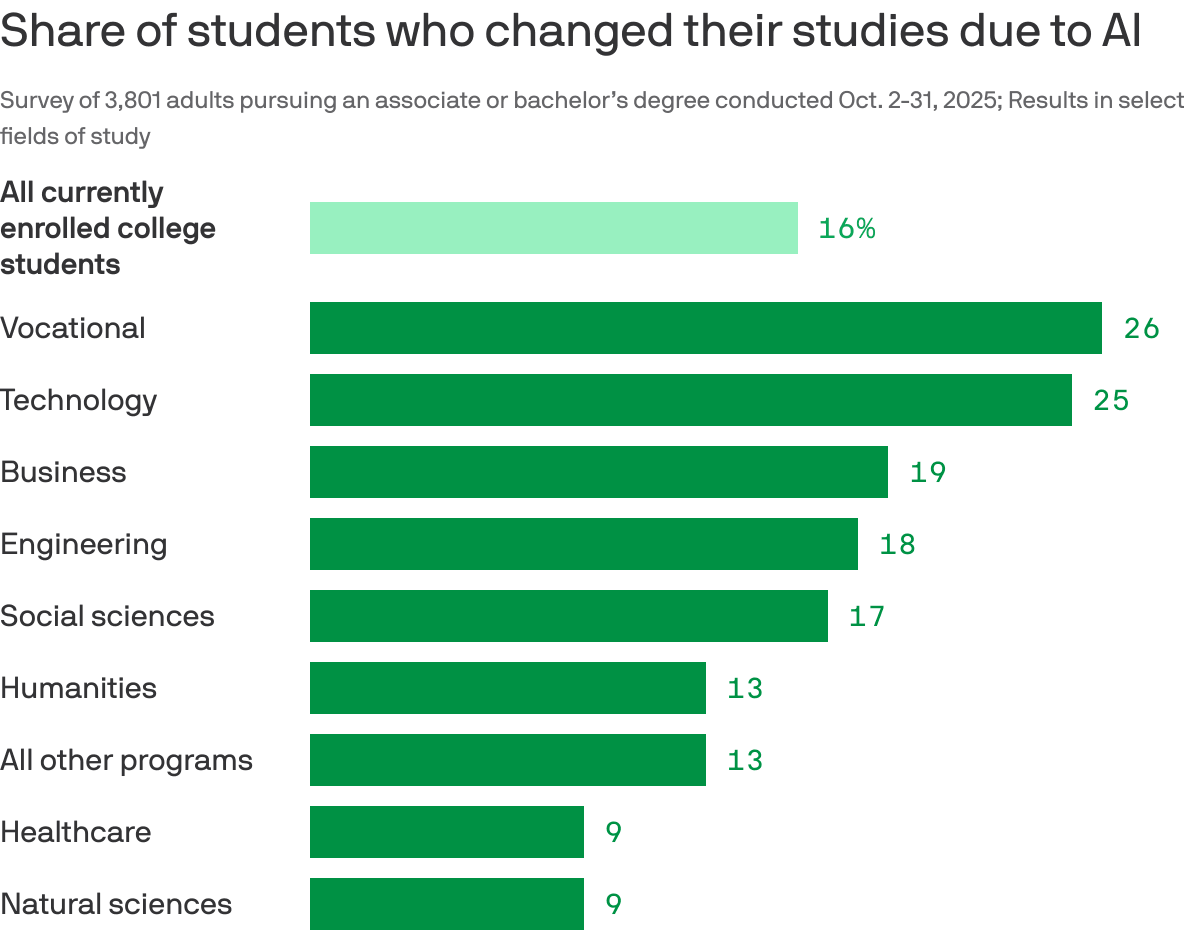
The numbers tell a story of imbalance. Among students currently enrolled, 14% have thought "a great deal" and 33% "a fair amount" about changing their major because of AI's potential impact on jobs. Male students are leading this charge, with 60% rethinking their paths compared to 38% of female students. It's even higher in tech and vocational fields, both hovering around 70%.
AI in the Classroom
But here's a twist. While students are eager to adapt, 42% of them say their schools are discouraging AI use in coursework. Talk about mixed signals! Only 11% reported outright bans, yet even in those environments, students can't resist exploring AI tools. A notable 15% of students use AI daily where it's discouraged, proving that curiosity isn't so easily stifled.
Courtney Brown from the Lumina Foundation hits the nail on the head: it's not just about knowing how to use AI. Students need to grasp its biases and broader implications. Whose data? Whose labor? Whose benefit? If institutions don't address this, they're setting students up for failure.
Future-Proofing Education
Christina Eid, a senior at American University, embodies the new student ethos. She's been fielding questions about AI proficiency in her job interviews and notes a sharp increase in employers' interest in AI skills, from 12% in 2024 to 30% in 2025.
Her advice? Students should take charge of their own AI education. Why wait for institutions to catch up? She says, "Get on with it." This is a story about power, not just performance. The benchmark doesn't capture what matters most if students are left unprepared for the real world.
So, the real question is, will colleges rise to the occasion and equip students with the skills they need? Or will students continue to fend for themselves, navigating an AI-driven future? The stakes are high, and the time to act is now.
Get AI news in your inbox
Daily digest of what matters in AI.