Building a Deal Desk Intelligence Agent with LangChain and OpenAI
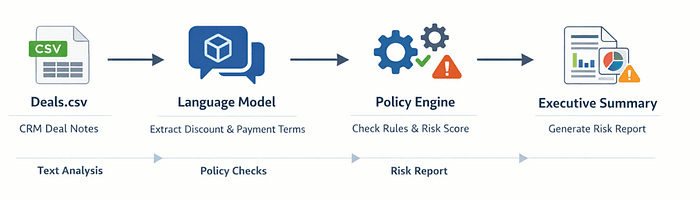
Author(s): Krishnan Srinivasan Originally published on Towards AI. Most enterprise AI journeys begin with prompts. Teams use language models to summarize documents, classify tickets, or generate insights from unstructured text. These are valuable capabilities and often the first step in adopting AI across the organization. However, operational teams such as Revenue Ops or Deal Desk typically need more than text generation. They need consistent, policy driven decisions. Beyond understanding language, the system must apply rules, enforce thresholds, and produce outcomes that are repeatable and auditable. Every day someone reads through dozens or hundreds of CRM notes and decides whether a deal is safe to approve or risky enough to escalate. A typical deal note might read: The customer is evaluating a multi year rollout across regions Procurement is pushing for a forty two percent discount due to competitive pressure Finance is requesting ninety day payment terms to align with their internal budget cycle A human reviewer immediately interprets this as: The deal requires escalation or approval The discount is too high The payment cycle is too long This reasoning is not artificial intelligence. It is simply business policy applied to messy language. This is where an agent based design becomes powerful. Instead of asking an LLM to decide everything, we split responsibilities. If there is one hard truth in enterprise AI, it is this: you cannot prompt your way to a reliable business process. While language models are exceptional at understanding the nuances of a salesperson’s CRM note, they can be unreliable at enforcing strict numerical policies such as consistently knowing if a 42% discount violates a 40% threshold. To build a Deal Desk Intelligence Agent that Revenue Ops can actually trust, we have to stop treating the LLM as a standalone decision-maker. Instead, we need a hybrid approach where AI interprets the language, but deterministic code enforces the rules. An agent coordinates the sequence of steps. Together they behave like a quiet digital analyst that reads notes, checks rules, and produces a clean summary for leadership. The flow is straightforward. We begin with a simple CSV export (deals.csv) that resembles a CRM extract. (Few samples rows are displayed below for reference). Each row contains a deal identifier and a free form note written by a salesperson. The LLM would read the note and extract structured information such as discount percentage and payment days. Small Python tools apply exact numeric thresholds. Finally the LLM converts the structured results into a short executive summary that a manager can read in seconds. LangChain as the Orchestration Backbone of the Agent LangChain is a framework designed to build applications where language models can interact with external tools, data, and logic in a structured and reliable way. Instead of using an LLM as a standalone text generator, LangChain enables it to act as part of an orchestrated system by calling Python functions, enforcing business rules, accessing datasets, and coordinating multi-step workflows. In the Deal Desk Intelligence Agent, LangChain is critical because it allows the LLM to focus on interpreting unstructured CRM notes while deterministic policy tools enforce exact thresholds, ensuring decisions remain consistent, auditable, and production-ready rather than purely prompt-driven. High-Level Architecture: At a high level, the Deal Desk Intelligence Agent architecture is divided into three functional zones that cleanly separate AI interpretation from deterministic business logic. Zone 1 (Data Input & Setup): The process begins here. Raw, unstructured CRM notes are ingested and the operational environment, including strict LLM parameters and numeric policy thresholds, is configured. Zone 2 (The Agentic Reasoning Loop): This serves as the system’s “Digital Analyst.” Within this loop, a LangChain orchestrator dynamically coordinates between an LLM that interprets messy human language and Python tools that mathematically enforce business rules, ensuring decisions are made without hallucination. Zone 3 (Structured Decisions & Reporting): The processed data finally flows here, generating both a granular, auditable CSV dataset for the operations team and a concise, LLM-synthesized executive summary for leadership. This separation guarantees that the system remains intelligent, perfectly consistent, and fully auditable. What follows is a step by step notebook implementation. In ten steps, we will walk through the entire process, starting with the environment setup and concluding with a generated executive summary. The link to access the notebook and the dataset is provided at the end of the blog. Step 1: Install Libraries The first step installs the libraries that orchestrate the workflow. LangChain handles tool calling and agent behavior. The OpenAI client provides access to the language model. Pandas loads tabular data. Dotenv loads environment variables so that keys and configuration stay outside the code. Step 2: Environment + Model Configuration This step sets up the environment and loads configuration for the notebook. pandas is imported for working with CSV data later, while load_dotenv reads values from a .env file so API keys and settings are not hardcoded in the code. The os module is used to access those environment variables, where your Open AI key is stored. load_dotenv() loads the variables into memory, after which the model name is set and retrieved using OPENAI_MODEL_NAME. This makes the LLM configurable, so you can switch models without changing the rest of the script. The final line simply confirms which model will be used for the run. Step 3: Initialize the LLM ChatOpenAI from LangChain acts as a wrapper around models hosted by OpenAI. The model=MODEL_NAME parameter dynamically selects the model you configured earlier through environment variables, keeping the setup flexible. Setting temperature=0 makes the responses deterministic and consistent, which is important for business workflows where decisions should be repeatable rather than creative. In short, this cell creates the LLM instance that powers the entire agent. Step 4: Load the data file This step loads the deals.csv file into a pandas DataFrame so each deal note can be processed programmatically Step 5: Define Deterministic Policy Rules as Agent Tools This step defines the deterministic business rules that the agent will use to make decisions. The @ tool decorator from LangChain turns […]
This article was originally published by Towards AI. View original article
Get AI news in your inbox
Daily digest of what matters in AI.
Key Terms Explained
The science of creating machines that can perform tasks requiring human-like intelligence — reasoning, learning, perception, language understanding, and decision-making.
When an AI model generates confident-sounding but factually incorrect or completely fabricated information.
An AI model that understands and generates human language.
Large Language Model.