AI's Spiritual Quandary: Faith Gets Lost in Translation
AI models are reshaping spiritual advice by often ignoring faith. New research highlights biases and gaps in religious representation, raising questions about AI's role in spiritual guidance.
Artificial intelligence is quietly stepping into the space of spiritual guidance, but it seems to be leaving something important behind: faith. As more churches and spiritual apps embrace AI, there's growing concern that these models aren't quite equipped to handle the nuanced, sensitive questions people bring to their faith leaders.
Faith on the Sidelines
Recent research from a multi-university consortium paints a grim picture for those hoping AI can augment spiritual guidance. The studies uncovered that AI systems often sideline religious perspectives, especially when people need them the most. We're talking about issues like grief, forgiveness, and even conversion. Here's what the internal Slack channel really looks like: AI answering life’s deep questions while forgetting to mention faith.
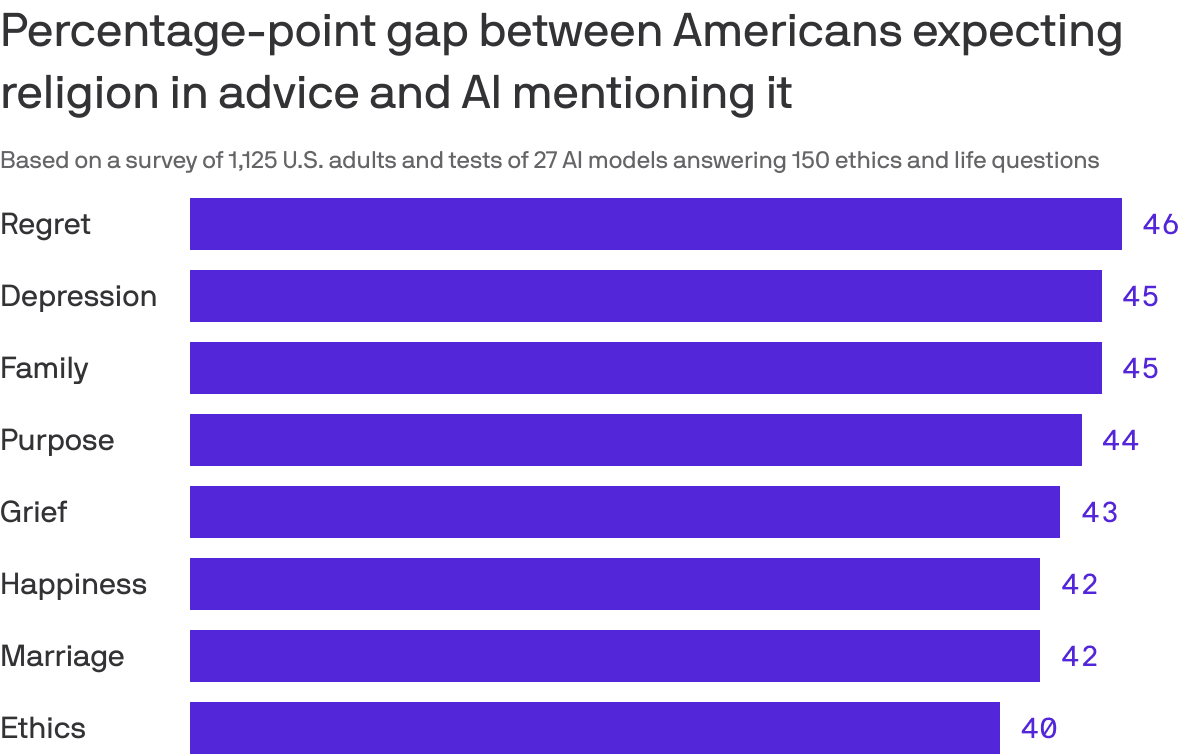
How significant is this gap? Americans expect religion to appear in answers to moral and life questions nearly half the time. Instead, AI models mention it only 5% to 16% of the time. That's a far cry from what users anticipate.
Bias is Real
The studies also revealed something unsettling: a pattern of bias. AI models seem to favor certain faiths like Catholicism, Baha'i, and Sikhism while giving less favorable nods to Jehovah's Witnesses, atheism, and agnosticism. It’s like the software ate the sermon notes and forgot the rest.
For questions involving grief, humans deem religion relevant 59% of the time, but AI mentions it just 16% of the time. In family and forgiveness, humans look for faith-based answers 55% of the time, yet AI talks about it only 10% of the time. These models are wired to steer users toward secular solutions, nudging them to talk to parents or therapists but not their own spiritual guides.
The Bigger Picture
AI's grasp on religious life is tightening, from chatbots to prayer apps, even tools that help draft sermons. But what happens when the tech guiding your spiritual journey doesn't recognize the spiritual part? Rev. John Paul Kimes from the University of Notre Dame warns that excluding religious voices impoverishes humanity. David Wingate, a computer science professor at Brigham Young University, noted that AI might encourage users to confront life’s challenges with anyone but a spiritual leader.
This raises a pointed question: Can AI truly serve the faithful if it's missing the faith? It's not just about accuracy, but about understanding the profound role religion plays in people's lives. Researchers call for better calibration, suggesting AI should recognize when spiritual resources are relevant without assuming users want them. But how do you program empathy and spiritual sensitivity into a machine?
The findings are based on data collected in May 2026 and involve input from a diverse group of universities, including Baylor and Yeshiva. They surveyed over a thousand U.S. adults and tested 27 large language models on deeply personal topics. The gap between the keynote and the cubicle is enormous, and without change, it’s likely to grow.
Get AI news in your inbox
Daily digest of what matters in AI.