AI Safety Gaps in Major Firms: A Wake-Up Call
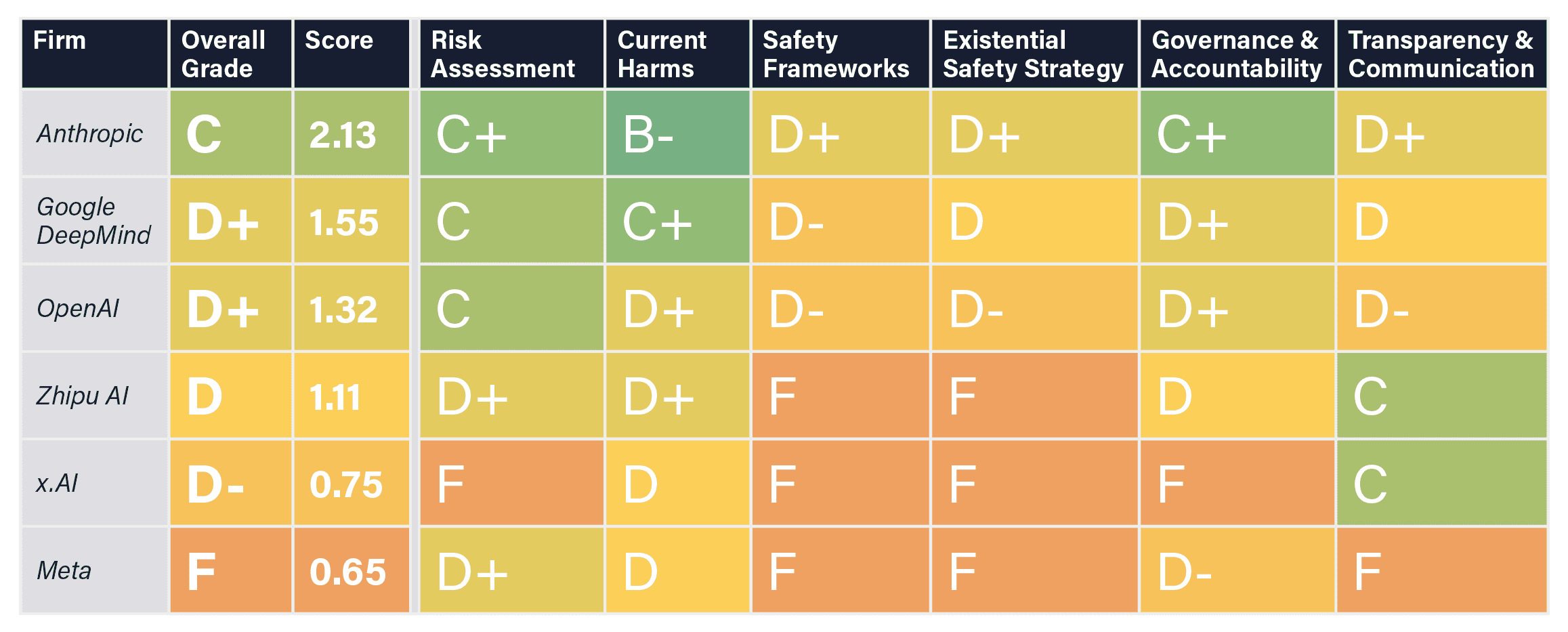
Top AI companies face scrutiny in a new safety review. Despite ambitions, significant gaps remain in ensuring AI systems stay beneficial and controlled.
In an eye-opening revelation, the Future of Life Institute's 2024 AI Safety Index has spotlighted substantial safety shortcomings in major AI companies, including Anthropic, Google DeepMind, Meta, OpenAI, x.AI, and Zhipu AI. Evaluated across six key categories, Risk Assessment, Current Harms, Safety Frameworks, Existential Safety Strategy, Governance & Accountability, and Transparency & Communication, the report reveals a concerning narrative.
Significant Disparities Exposed
While some companies show promise in certain areas, the report lays bare disconcerting gaps in risk management. The review panel, comprising leading AI and governance experts, found all flagship models vulnerable to adversarial attacks. Despite these companies' grand ambitions to develop systems that could surpass human intelligence, strategies to ensure these systems remain beneficial and under control are largely absent.
David Krueger, an Assistant Professor at Université de Montreal, couldn't have been blunter: "It's horrifying that the very companies whose leaders predict AI could end humanity have no strategy to avert such a fate." Such a stark statement raises an unsettling question: if the architects of AI aren't prepared for its potential consequences, who will be?
A Safety Illusion?
Stuart Russell of UC Berkeley added weight to these concerns, arguing that current AI safety measures lack quantitative guarantees. He warns that as AI systems grow more complex, ensuring their safety might become impossible. "In other words," Russell asserts, "it's possible that the current technology direction can never support the necessary safety guarantees, in which case it's really a dead end." This isn't just a call for more solid frameworks. it's a challenge to the very trajectory of AI development.
Accountability and Future Steps
The report, based on publicly available information and company responses to an FLI survey, highlights a pressing need for improved accountability. Competitive pressures, it suggests, are leading firms to sidestep key safety questions. Max Tegmark, FLI's president, emphasized the importance of the Safety Index in providing a clear picture of where AI labs stand on these issues.
Yoshua Bengio, a leading voice in AI and governance, underscored the value of initiatives like this Index. He believes they not only offer insights into safety practices but also push companies toward more responsible approaches. Is it time for the industry to recognize that safety isn't just a checkbox but a fundamental requirement?
The findings of this report should serve as a critical wake-up call to both the industry and regulators. If AI is to genuinely benefit humanity, it must be designed with safety at its core. The need for change is urgent, and the path forward is one that demands both immediate action and long-term commitment.
Get AI news in your inbox
Daily digest of what matters in AI.
Key Terms Explained
The broad field studying how to build AI systems that are safe, reliable, and beneficial.
An AI safety company founded in 2021 by former OpenAI researchers, including Dario and Daniela Amodei.
A leading AI research lab, now part of Google.
The AI company behind ChatGPT, GPT-4, DALL-E, and Whisper.