AI-Powered Robodogs: The Future of Search and Rescue
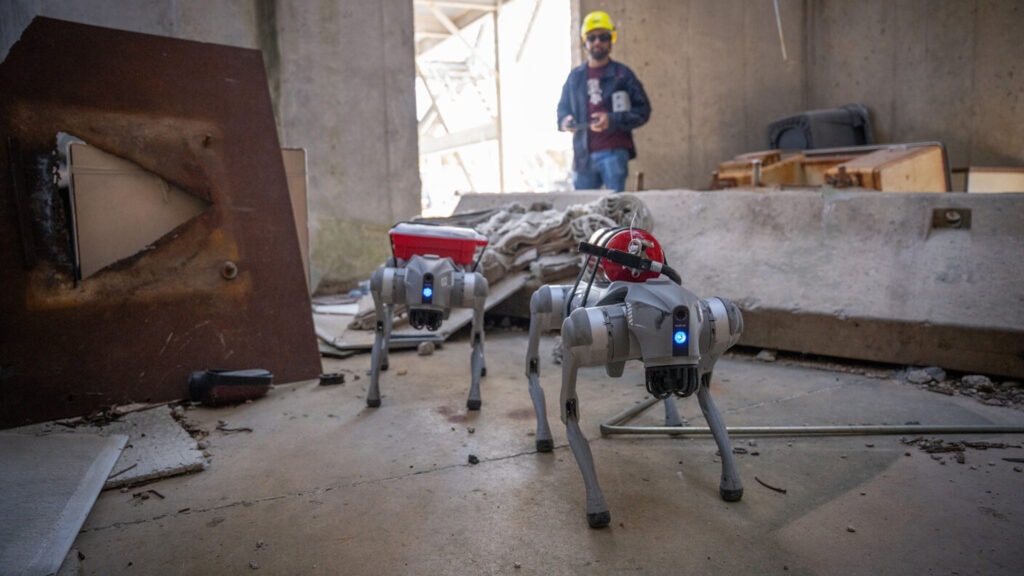
Texas A&M's engineering students have created AI-driven robotic dogs poised to transform emergency response. These advanced robots navigate chaos with precision, potentially revolutionizing disaster management.
Amidst the chaos of a disaster zone, where every second counts, the introduction of a robotic dog equipped with an elephantine memory may just alter search and rescue. Developed by engineering students at Texas A&M University, these AI-powered robotic dogs aren't mere automatons following commands. They're designed to navigate complex environments with precision, potentially transforming the way we approach emergency operations.
The Minds Behind the Machine
Leading the charge on this innovative venture are Sandun Vitharana, a committed engineering technology master's student, and Sanjaya Mallikarachchi, a doctoral student in interdisciplinary engineering. Their brainchild is a robotic dog capable of processing voice commands, leveraging AI, and utilizing camera input for path planning and object identification. This isn't your average terrestrial robot.
What sets this creation apart is its memory-driven navigation system founded on a multimodal large language model (MLLM). By interpreting visual inputs, this system generates routing decisions, combining environmental image capture with high-level reasoning. The result? A hybrid control architecture that marries strategic planning with real-time adjustments.
Beyond Conventional Navigation
The evolution of robot navigation from basic landmark-based methods to sophisticated computational systems has been remarkable. Yet navigating unpredictable terrains like disaster zones or remote outposts has remained a significant challenge. It's here that these robotic dogs may truly shine.
While both robot dogs and language model-based navigation exist independently, combining them in a custom MLLM with visual memory presents a novel approach. “Academic and commercial systems have previously integrated language or vision models,” said Vitharana. “But our structured use of MLLM-based memory navigation, guided by custom pseudocode, is unique.”
Supported by the National Science Foundation, Vitharana and Mallikarachchi set out to demonstrate how vision, memory, and language could interact within a robotic system. The result is a robot capable of deftly avoiding collisions while executing high-level planning using its custom MLLM for real-time analysis and decision-making.
Wide-Reaching Applications
Beyond emergency response, the potential applications for these robodogs are vast. Imagine hospitals or large facilities utilizing these robots to speed up operations. Consider how they might assist individuals with visual impairments, explore minefields, or perform reconnaissance in hazardous areas. The possibilities are boundless.
International collaboration has been important, with contributions from Nuralem Abizov, Amanzhol Bektemessov, and Aidos Ibrayev from Kazakhstan's International Engineering and Technological University, as well as HG Chamika Wijayagrahi from the UK's Coventry University, ensuring a solid ROS2 infrastructure and effective map design.
These robotic dogs showcased their capabilities at the 22nd International Conference on Ubiquitous Robots, leaving a lasting impression. As Mallikarachchi aptly noted, “, this kind of control structure will likely become a common standard for human-like robots.”
Ultimately, the question isn't whether these robots will transform emergency operations, but how quickly and in what capacity. In a world where disaster can strike at any moment, such innovation feels less like a luxury and more like a necessity.
Get AI news in your inbox
Daily digest of what matters in AI.
Key Terms Explained
An AI model that understands and generates human language.
An AI model with billions of parameters trained on massive text datasets.
AI models that can understand and generate multiple types of data — text, images, audio, video.
The ability of AI models to draw conclusions, solve problems logically, and work through multi-step challenges.