AGIBOT's Genie Envisioner 2.0: Transforming AI Training with World Simulators
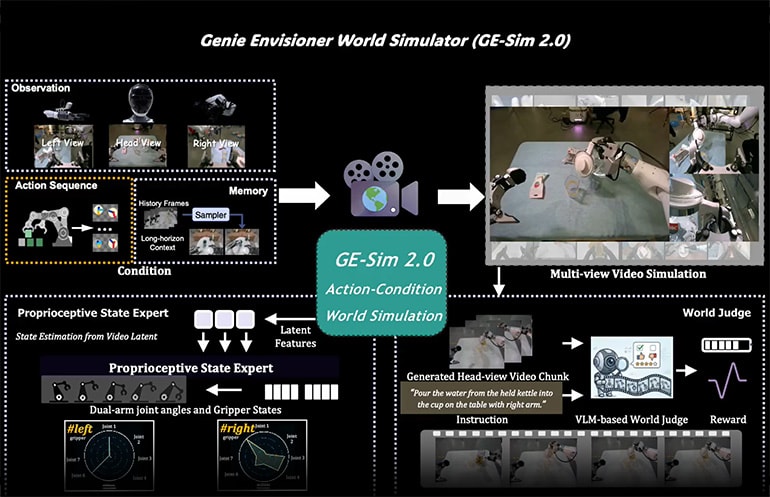
AGIBOT's Genie Envisioner 2.0 revolutionizes AI training by shifting from world models to interactive simulators, enhancing robot learning efficiency.
AGIBOT has unveiled Genie Envisioner 2.0, a significant leap in the evolution of AI training systems. Dubbed the GE 2-Sim, this release marks a transition from traditional world models to what AGIBOT calls 'world simulators'. The key difference? These simulators allow robots to not just understand but learn within digitally generated environments.
Why Simulators Matter
In 2025, AGIBOT introduced the Genie Envisioner, a platform that integrated vision, language, and action to give robots a basic understanding of their surroundings. Now, with 2.0, they're moving beyond static models to environments where actions dictate outcomes. This is essential because the container doesn't care about your consensus mechanism. It's about how efficiently a system can learn and adapt.
The shift reflects a broader trend in AI technology. Instead of relying solely on real-world data, which is expensive and often limited, robots can now be trained in controlled, scalable digital worlds. Imagine the implications for industries reliant on automation. More efficient training could lead to faster deployment and adaptation in real-world scenarios.
The Mechanics of GE 2-Sim
At its core, the Genie Envisioner 2.0 uses a framework called the world action model (WAM). This system captures the entire cycle of action and reaction, from a robot's movement to the resultant change in environment. The goal is straightforward: enhance the fidelity of simulations to the point where they can replace physical trials.
AGIBOT has introduced several components to make this possible. EnerVerse-AC models future predictions based on actions, while GE-Sim serves as a neural simulator for policy evaluation. Meanwhile, their Real2Edit2Real framework allows real-world data to be manipulated and extended for greater diversity. The ROI isn't in the model. It's in the 40% reduction in document processing time. Faster and more varied data processing leads to smarter AI.
Scaling AI with Simulated Worlds
Why should anyone care about these technical intricacies? Because transforming models into interactive simulators could redefine the limits of AI. Robots traditionally learn from human demonstrations. But what if they could explore and innovate independently within a virtual universe? This isn't about AI understanding the world anymore, it's about AI acting within it.
Consider the potential for industries like logistics, where precision and adaptability are key. Could these simulators lead to more efficient supply chain management? Could it reduce costs and improve service delivery? These are questions AGIBOT's innovations are beginning to answer.
The Genie Envisioner 2.0 pushes the boundaries of what's possible in AI training. By evolving from simple understanding to dynamic learning within models, AGIBOT is setting the stage for a new era in robot intelligence. Enterprise AI is boring. That's why it works. And in this case, it's working to make a smarter, more adaptable future possible.
Get AI news in your inbox
Daily digest of what matters in AI.