A New Sense of Touch: Revolutionizing Robotic Interaction
Researchers at Cambridge have crafted a miniaturized tactile sensor, bringing robots closer to human-like touch. This breakthrough could transform robotics, prosthetics, and more.
Robots are gaining ground in vision and movement, but touch has long been a weak spot. Now, researchers at the University of Cambridge are changing the game with a new tactile sensor that's bringing robots closer to human-like touch.
The Breakthrough
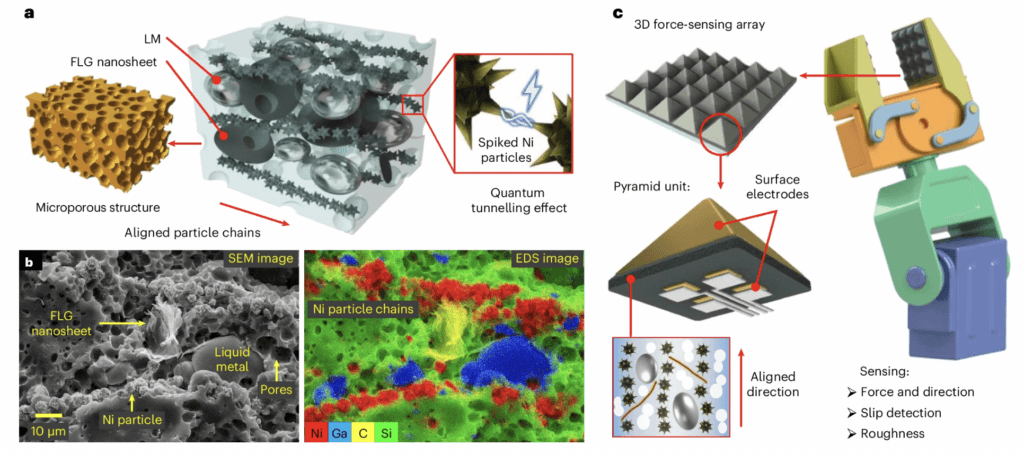
This innovative 'skin' is crafted from liquid metal composites and graphene, a marvel that allows robots to feel not just pressure, but the direction of forces and surface textures too. Imagine a robotic finger sensing a surface as finely as a human fingertip. It's a reality now, with results published inNature Materials.
Professor Tawfique Hasan, leading the research at the Cambridge Graphene Centre, points out a major issue with current tactile sensors: they're either too bulky or too fragile. This new material, however, isn't just about size. It's about toughness and sensitivity, critical for practical deployment in the field.
Designing for Sensitivity
Inspired by human skin, the researchers created tiny pyramid structures within the material, concentrating stress and enabling detection of minute forces. Some pyramids measure just 200 micrometres across. That's sensitivity right there.
The sensors go beyond simple touch, distinguishing shear forces from normal pressure. This capability is important. It means a robot can sense an object slipping and adjust its grip in real time. Such precision transforms how robots interact with the world.
Beyond Robotics
The implications stretch far beyond robotics. In prosthetics, where touch feedback is vital, these sensors could offer users a more natural interaction with their environment. Imagine prosthetic limbs providing real-time feedback, dramatically improving user experience.
these sensors hold promise for fields like minimally invasive surgery. In such delicate operations, conventional force sensors are too clunky. But these tiny, precise sensors could change the landscape.
Why does this matter? Well, as robots step out of controlled environments and into our homes and hospitals, their ability to feel could redefine human-machine interaction. This isn't just about better robots. It's about machines that genuinely understand their world.
The Future of Touch
Researchers are already looking at further miniaturizing these sensors. Imagine them as dense as mechanoreceptors in human skin. Future iterations could even include temperature and humidity sensing, creating a truly multimodal artificial skin.
The farmer I spoke with put it simply: "This isn't about replacing workers. It's about reach." In places like Nairobi, where automation looks different, such innovations could help scale operations without cutting jobs.
So, what's next? With a patent already filed through Cambridge Enterprise, the future of robotic touch isn't just science fiction. It's on the horizon. And it's set to change the way we think about interaction, both human and machine.
Get AI news in your inbox
Daily digest of what matters in AI.